
Baking Powder vs Baking Soda: Differences, Swaps and Conversions
The difference between baking powder vs baking soda comes down to acid. Baking soda is pure sodium bicarbonate: it needs an acidic ingredient in the recipe, such as buttermilk, yogurt, brown sugar or lemon juice, to release the gas that makes a cake or cookie rise. Baking powder is baking soda with the acid already added, plus a little cornstarch, so it only needs moisture and heat. Baking soda is about three to four times stronger, so they are not swapped spoon for spoon.
This guide explains what each leavener does, why many recipes use both, how to substitute one for the other, and how to tell if yours is still fresh.
Key Takeaways
- Baking soda = sodium bicarbonate. It needs an acid in the recipe to work.
- Baking powder = baking soda + a dry acid + cornstarch. It works with moisture and heat alone.
- 1 tsp baking soda ≈ 3 tsp baking powder in leavening power.
- Recipes use both when they contain some acid but need more lift than the soda alone gives.
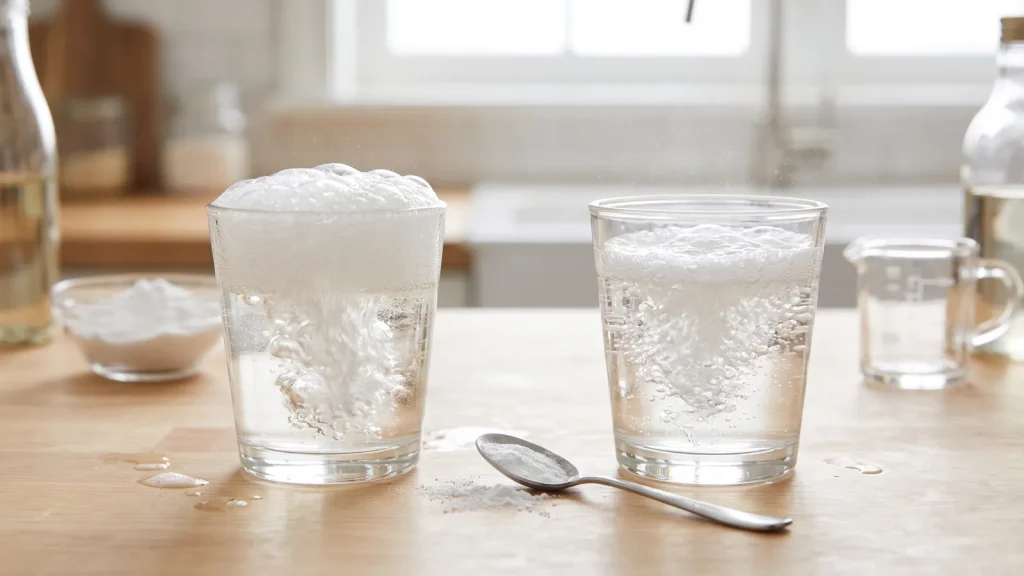
- Test freshness: baking soda fizzes in vinegar, baking powder fizzes in hot water.
What Is Baking Soda?
Baking soda is sodium bicarbonate, a fine white alkaline powder. On its own it does almost nothing in a batter. When it meets an acid, it reacts at once and gives off carbon dioxide, the bubbles that lift and lighten a bake.
Common acidic ingredients that activate baking soda:
- Buttermilk, yogurt, sour cream and kefir
- Brown sugar, molasses and honey
- Natural (non-Dutch-processed) cocoa powder and chocolate
- Lemon juice, vinegar and fruit purees such as bananas or applesauce
Baking soda also raises the pH of a dough. That makes cookies spread more and brown more deeply, and it neutralizes the tang of buttermilk or yogurt. Too much leaves a soapy, metallic taste.
What Is Baking Powder?
Baking powder is baking soda pre-mixed with one or two dry acids (such as monocalcium phosphate or sodium aluminum sulfate) and a little cornstarch to keep it dry. Because the acid is included, it works in recipes without any acidic ingredients, such as vanilla cake made with plain milk.
Most baking powder sold in the US is double-acting:
- The first reaction starts when it gets wet, as you mix the batter.
- The second reaction starts in the oven, once the batter heats up.
That second burst gives a reliable rise even if the batter sits for a few minutes before baking. Single-acting baking powder reacts only when wet, so the batter has to go into the oven right away.
Baking Powder vs Baking Soda at a Glance
| Baking soda | Baking powder | |
|---|---|---|
| What it is | Sodium bicarbonate | Baking soda + dry acid + cornstarch |
| Needs an acid in the recipe? | Yes | No |
| Strength | About 3 to 4 times stronger | Milder |
| When it reacts | As soon as it meets acid and liquid | When wet, then again with heat (double-acting) |
| Effect on browning | More browning, more spread | Lighter color, puffier shape |
| Typical amount | ¼ tsp per cup of flour | 1 to 1½ tsp per cup of flour |
| Common in | Cookies, banana bread, buttermilk pancakes | Cakes, biscuits, muffins, scones |
| Shelf life once opened | Long if kept dry | About 6 to 12 months |
Why Do Some Recipes Use Both?
Many recipes, from chocolate chip cookies to buttermilk pancakes, use baking soda and baking powder. Each has a job:
- Baking soda neutralizes the acid in ingredients like buttermilk, brown sugar or yogurt, which improves flavor and browning. But a recipe usually doesn’t contain enough acid to need more than a pinch of soda.
- Baking powder then adds the remaining lift without needing more acid.
Using both lets a baker control rise, spread, color and flavor separately. That is why swapping one for the other changes more than just the height.
Can You Use Baking Powder Instead of Baking Soda?
Yes, with more of it. Because baking soda is about three times stronger, use 3 teaspoons of baking powder for every 1 teaspoon of baking soda. Expect:
- Lighter color and less spread, especially in cookies
- A slightly more tangy taste, since the recipe’s acid is no longer fully neutralized
- A small chance of a bitter note if the amount gets large
This swap works best when the recipe calls for a small amount of soda (½ teaspoon or less). For a recipe that leans heavily on soda, such as a very dark chocolate cake, the result changes more.
Can You Use Baking Soda Instead of Baking Powder?
Only if you also add an acid. Baking soda alone in a recipe without acid leaves a soapy taste and gives little rise. For 1 teaspoon of baking powder, use:
- ¼ teaspoon baking soda + ½ cup buttermilk or yogurt in place of ½ cup of the recipe’s milk, or
- ¼ teaspoon baking soda + ½ teaspoon lemon juice or vinegar added with the liquids.
Get the batter into the oven quickly: homemade combinations act all at once, like single-acting powder. For more options, see our list of the best substitutes for baking soda.
Baking Powder and Baking Soda Conversion Chart
| Recipe calls for | Replace with |
|---|---|
| ½ tsp baking soda | 1½ tsp baking powder |
| 1 tsp baking soda | 3 tsp (1 tbsp) baking powder |
| 1 tsp baking powder | ¼ tsp baking soda + ½ tsp lemon juice or vinegar |
| 1 tbsp baking powder | ¾ tsp baking soda + 1½ tsp lemon juice or vinegar |
| 1 tsp baking powder (with buttermilk) | ¼ tsp baking soda + ½ cup buttermilk (reduce other liquid by ½ cup) |
How Much Baking Powder or Baking Soda Per Cup of Flour?
Most recipes land close to these amounts:
- Baking powder: 1 to 1½ teaspoons per cup (120 g) of flour. Biscuits and scones sometimes use up to 2.
- Baking soda: about ¼ teaspoon per cup of flour, matched to the acid in the recipe. Roughly ½ teaspoon of soda neutralizes 1 cup of buttermilk or yogurt.
If a recipe uses far more than this, the bake can rise fast and then collapse, or taste bitter.
How to Tell If Baking Powder or Baking Soda Is Still Good?
Both lose strength over time, baking powder faster because moisture from the air sets off its acid. Test before an important bake:
- Baking powder: stir ½ teaspoon into ¼ cup of hot water. It should bubble right away.
- Baking soda: add ¼ teaspoon to 2 teaspoons of vinegar. It should fizz strongly.
Weak or no bubbles means it’s time for a new container. Keep both tightly closed in a cool, dry cupboard, away from the stove and dishwasher steam. If you are shopping for a new tin, our guide to the best aluminum-free baking powder compares the main brands.
What Happens If You Use Too Much or Too Little?
- Too much baking soda: soapy or metallic taste, dark brown or greenish crumb, cookies that spread thin.
- Too much baking powder: bitter taste, a coarse crumb, and cakes that rise fast and sink in the middle.
- Too little of either: dense, heavy bakes that don’t rise.
- Forgot it entirely: flat cookies and brick-like cakes. Some recipes are designed that way on purpose, like this banana bread with no baking soda or powder, but most are not.
Which Leavener Should You Use?
Follow the recipe whenever you can: the leavener is balanced against its acids. If you must swap, baking powder can stand in for baking soda at three times the amount, and baking soda can stand in for baking powder only with an added acid such as buttermilk or lemon juice. When you bake often, keep both in the pantry, and replace the baking powder about once a year.
Frequently Asked Questions
Are baking powder and baking soda the same thing?
No. Baking soda is pure sodium bicarbonate and needs an acid to work. Baking powder already contains baking soda plus an acid, so it works with just moisture and heat.
What is baking powder made of?
Baking soda, one or two dry acids such as monocalcium phosphate or sodium aluminum sulfate, and cornstarch to absorb moisture.
Is bicarbonate of soda the same as baking soda?
Yes. “Bicarbonate of soda” or “bicarb” is the British name for baking soda.
Can I make baking powder at home?
Not one you can store, because the dry acids in baking powder are not sold for home use. For a single bake, replace each teaspoon of baking powder with ¼ teaspoon baking soda plus ½ teaspoon lemon juice or vinegar (or ½ cup buttermilk in place of ½ cup of the milk), and bake right away.
Why do cookies use baking soda instead of baking powder?
Baking soda makes cookies spread and brown, and it reacts with the brown sugar’s acidity. Baking powder makes them puff up and stay pale and cakey.