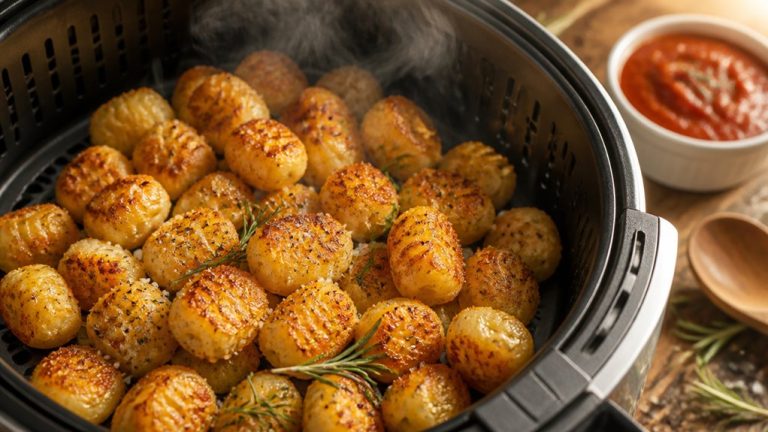

Is Air Crisp the Same as Air Fryer or Just Branding?
You’ll find that Air Crisp and traditional air frying use the same basic technology: rapid circulation of superheated air to crisp food with little oil.
Air Crisp is usually a branded mode with preset controls rather than a different cooking method.
Both rely on hot airflow, even heat distribution, and Maillard browning for crisp results.
Performance depends more on appliance design and airflow than the name itself.
Keep exploring to understand appliance features and cooking tips that optimize crispness.
Key Takeaways
- Air Crisp is a branded air-fry mode using rapid hot-air circulation similar to traditional air frying technology.
- Both Air Crisp and air fryers cook by circulating superheated air to crisp food with minimal oil.
- Differences between Air Crisp and air frying mainly stem from branding, preset controls, and appliance design.
- Air Crisp is not a fundamentally different cooking method but a specialized preset within air frying functions.
- Cooking performance depends more on appliance airflow and heating element design than the Air Crisp label.
A Head-To-Head Comparison: Key Differences
| Comparison Factor | Air Crisp | Air Fryer | Key Takeaway |
|---|---|---|---|
| Core Cooking Method | Uses superheated air and a fan to crisp food | Uses rapid hot-air circulation to mimic frying | Both rely on the same basic principle |
| Mode vs. Appliance | Usually a preset function inside a multi-cooker or air fryer | A standalone appliance or cooking function | Air Crisp is often a mode, not a separate method |
| Temperature Range | Often reaches up to 400°F, depending on model | Ranges vary by brand and appliance design | Model specs matter more than the label |
| Cooking Controls | May include preset settings for convenience | May offer manual controls or multiple functions | Ease of use depends on the interface |
| Crisping Performance | Strong crisping when airflow is well designed | Strong crisping with proper basket use and preheating | Airflow and basket space drive the best texture |
| Best For | Users who want a branded preset and simple operation | Users who want a dedicated crisping appliance | Choose based on features, not just the name |
What Is Air Crisp Technology?

When you hear about Air Crisp technology, it refers to a specific air-frying feature designed to circulate superheated air rapidly around food, creating a crispy exterior without using much oil.
You’ll find it primarily as a branded function in certain appliances, like Ninja’s air fryers. This method employs a heating element paired with a fan to push hot air, often reaching up to 400°F, through a compact chamber.
This ensures even browning and crispness. While Air Crisp settings might include presets tailored to particular foods, the core cooking principle remains the same as conventional air frying: circulating hot air dries and crisps food surfaces efficiently.
To get the best results, you should follow the appliance’s manual for temperature, timing, and basket loading. Performance depends on design and airflow rather than the feature name alone.
Many Cuisinart air fryers utilize advanced airflow technologies such as AirAdvantage technology to optimize hot air circulation for fast and even crisping results.
Air Crisp vs. Traditional Air Frying: What’s the Difference?
Understanding Air Crisp technology sets the stage for comparing it directly with traditional air frying. Both rely on circulating hot air to crisp food.
Air Crisp often refers to a branded function with preset controls, while traditional air frying is a generic cooking method found across many models. You’ll find differences mainly in appliance design, temperature limits, and specific settings rather than fundamental technique.
This distinction in technology is somewhat similar to how Dream Whip introduces tiny air pockets in cake batter to create a delicate texture.
| Feature | Air Crisp | Traditional Air Frying |
|---|---|---|
| Definition | Branded air-fry mode | Generic hot air convection |
| Temperature Range | Up to 400°F (model-dependent) | Varies by appliance |
| Controls | Preset modes often included | Manual or preset options |
| Application | Crisping with minimal oil | Similar, with wide device range |
You should treat Air Crisp as a specialized air-fry function unless otherwise specified.
How Hot Air Circulation Creates Crisp Food in Both Methods?
So, here’s the deal: when you use a fan to circulate hot air around your food, it really works wonders. The rapid movement of that hot air helps to remove moisture from the surface, which is super important for achieving that nice, crispy texture. Plus, it kicks off the Maillard reaction, which is what gives your food that delicious browning.
Now, because the airflow is even, it distributes heat uniformly. This means you get a fantastic, crisp exterior without needing to soak your food in oil. Pretty neat, right?
Understanding how this process affects texture can really help you get the best results, whether you’re using the Air Crisp feature or an air fryer.
Many advanced models utilize 360° hot air circulation to ensure even cooking and reduced smoke during the crisping process.
Mechanism of Hot Air
Circulating hot air rapidly around food uses convection to remove moisture from the surface and promote browning through the Maillard reaction.
You’ll find that both Air Crisp and air fryer methods rely on this principle: a heating element generates heat, while a fan forces hot air to flow evenly around the food.
This constant circulation accelerates drying and cooks the exterior efficiently, resulting in a crispy texture without deep frying.
| Component | Function | Effect on Food |
|---|---|---|
| Heating Element | Generates high-temperature air | Initiates cooking process |
| Fan | Circulates hot air evenly | Secures uniform crisping |
| Cooking Chamber | Contains airflow | Maintains consistent heat |
Understanding this mechanism helps you optimize cooking times and airflow for best results. Most stainless steel air fryers incorporate dual heating elements and convection fans to enhance even heat distribution and crisping efficiency.
Browning and Crisping Process
The movement of hot air around food triggers a series of chemical and physical changes that produce browning and crisping. As hot air circulates rapidly, it removes moisture from the food’s surface, initiating dehydration that firms the exterior.
Simultaneously, the Maillard reaction occurs as amino acids and reducing sugars react under heat, creating the characteristic brown color and complex flavors. The convection process maintains consistent high temperatures, ensuring uniform heat transfer and promoting even crust formation.
This hot air circulation mimics shallow frying without submerging food in oil, allowing you to achieve crisp textures with minimal added fat. Both Air Crisp and traditional air-fry settings rely on these principles, using superheated air, often up to 400°F, to drive these reactions efficiently within the appliance’s cooking chamber.
The rapid hot-air circulation and smaller cooking chamber in air fryers contribute to faster cooking times and enhanced crisping effects, making them ideal for quick meals and small batches with optimal airflow efficiency.
Airflow’s Role in Texture
Hot air movement plays a crucial role in developing the crisp texture that defines both Air Crisp and traditional air-frying methods.
When you use either method, a fan circulates superheated air, often reaching up to 400°F, around the food. This rapid air circulation removes surface moisture and evenly distributes heat, which triggers the Maillard reaction responsible for browning.
As moisture evaporates and the exterior dries, the food’s surface becomes crisp without needing much oil. You’ll notice that airflow design, basket shape, and speed impact how uniformly your food crisps.
To optimize texture, avoid overcrowding, ensuring hot air reaches all surfaces. Whether labeled Air Crisp or Air Fry, the principle remains the same: controlled hot air circulation efficiently creates that desired crispy finish.
Preheating your air fryer before cooking ensures even heat distribution, which enhances the crispness and consistency of your food’s texture.
Appliance Features Affecting Air Crisp and Air Frying
Consider how specific appliance features shape the effectiveness of Air Crisp and air frying functions. Key factors include fan design, heating element placement, and basket capacity.
Strong, well-positioned fans guarantee rapid, even hot-air circulation, critical for uniform browning and crisping. Heating elements capable of reaching higher temperatures, up to 400°F in some models, enhance Maillard reactions for better texture.
Basket shape and size affect airflow; overcrowding reduces crispness by impeding heat distribution. Control interfaces also matter. Presets tailored to Air Crisp or air-fry modes optimize timing and temperature for particular foods.
Since Air Crisp typically represents a branded function, you should consult your appliance manual to understand its specific settings and limitations. Ultimately, these features collectively determine how well your appliance achieves the desired crispness through air frying principles.
Additionally, dual-speed fans and 360º air circulation technology play a crucial role in maintaining consistent heat distribution and achieving even crisping results.
Appliances With Air Crisp vs. Air Fryer Modes
When you compare appliances featuring Air Crisp modes to those with standard air fryer settings, the distinction often lies in branding and user interface rather than fundamental cooking technology.
Both rely on rapid hot-air circulation to crisp food with minimal oil, using similar heating elements and fan designs.
Appliances with Air Crisp modes, like certain Ninja models, may offer preset temperatures and specialized controls tailored to their design, but the core cooking process remains air frying.
Air fryer appliances may include additional functions, such as baking, roasting, and dehydrating, beyond air frying.
Differences in basket capacity, airflow configuration, and maximum temperature affect performance more than the mode name itself.
Always consult your appliance manual for specific instructions, as Air Crisp is basically a branded air-fry mode rather than a distinct cooking method.
Many air fryers also feature 360° hot air circulation to ensure even crisping by drying surface moisture efficiently.
Common Myths About Air Crisp and Air Frying
You might think that Air Crisp and air frying are totally different methods, but here’s the scoop: they both use circulating hot air to get that delicious crispiness in your food. Pretty cool, right?
A lot of folks assume that Air Crisp is some kind of special technology, but it’s often just a branded air-frying function. The cooking principles are really similar!
Many modern air fryer models, including Ninja’s, feature dual-zone technology that enhances cooking efficiency by allowing independent temperature control in separate baskets.
Air Crisp Versus Air Frying
Among common misconceptions, many assume that Air Crisp technology fundamentally differs from traditional air frying, but this isn’t the case.
Both methods use a heating element combined with a fan to circulate hot air around the food, producing a crisp exterior with minimal oil.
Air Crisp often refers to a branded function, like Ninja’s Air Crisp mode, while air frying describes the general cooking technique.
Regardless of label, the cooking principle remains the same: rapid hot air circulation browns and crisps food efficiently.
Differences you might notice come from appliance design, temperature limits, and preset controls, not the underlying method.
When using Air Crisp or air fry modes, follow your model’s instructions closely to optimize crispness and cooking time.
Typically, these methods achieve faster cooking by concentrating heat in a smaller chamber with the fan positioned close to the food, a key factor in air fryer speed and efficiency.
Debunking Common Misconceptions
Although Air Crisp and air frying share the same core cooking principle, several misconceptions persist about their differences and effectiveness.
You might hear claims that Air Crisp uses a unique method or produces healthier results compared to air frying. In reality, both rely on circulating superheated air to crisp food with minimal oil.
Misunderstandings often arise from branding rather than technology. Common myths you should be aware of include:
Air Crisp is a fundamentally different cooking process from air frying.
Air Crisp appliances always achieve better crispness or faster cooking.
Using Air Crisp means you can’t use traditional air-fry settings interchangeably.
Understanding these helps you make informed choices and avoid confusion driven by marketing rather than function.
Expected Results From Air Crisp and Air Fry Settings
Expect consistent crispness and browning when using Air Crisp or Air Fry settings, as both rely on circulating hot air to cook food evenly.
The rapid airflow removes moisture from the food’s surface, creating a crisp texture similar to traditional frying but with minimal oil.
You’ll notice that foods like fries, chicken, or vegetables develop a browned exterior while maintaining a tender interior.
Temperature control, typically up to 400°F, and fan speed are key factors influencing these results.
However, slight variations may occur depending on the appliance model, basket design, and airflow efficiency.
Both settings achieve comparable outcomes, so focus on following your device’s recommended time and temperature guidelines to optimize crispness and cooking uniformity without overcooking or underbrowning.
Tips to Maximize Crispness Using Air Crisp and Air Fryer Modes
Optimize crispness in Air Crisp and Air Fryer modes by ensuring proper airflow around the food. Avoid overcrowding the basket as it limits heat circulation, leading to uneven crisping. Preheat your appliance to the recommended temperature for consistent results.
Ensure proper airflow and avoid overcrowding for even crisping; always preheat your air fryer for best results.
To maximize crispness effectively:
Shake or turn food halfway through cooking to promote even browning. Lightly coat food with oil to improve surface texture without excessive greasiness. Use temperature and timing settings specified in your model’s manual for peak performance.
Following these tips leverages the rapid hot air circulation principle both modes use. This targeted approach enhances moisture evaporation and surface browning, delivering the desired crisp texture without deep frying.
Choosing Between Air Crisp and Air Fryer Settings
When selecting between Air Crisp and Air Fryer settings, you’ll often find that both aim to achieve similar results using rapid hot air circulation.
Subtle differences in temperature limits, presets, and airflow patterns can affect cooking outcomes. You should consult your appliance manual to understand these specifics.
Air Crisp often features preset temperatures, commonly up to 400°F, optimized for crisping. Air Fryer modes might offer broader temperature ranges or multiple functions.
Consider your food type and desired texture; some models recommend shaking or turning food to guarantee even browning. Avoid overcrowding the basket to maintain effective airflow regardless of the setting.
Ultimately, choosing between settings depends on your model’s design and controls, but both operate on the same fundamental hot-air frying principle.
Frequently Asked Questions
Can I Use Air Crisp Technology for Baking Desserts?
Yes, you can use Air Crisp technology for baking desserts if your appliance supports it.
Air Crisp circulates hot air for even cooking, similar to an air fryer, so it can bake items like cookies or small cakes.
However, check your model’s manual for recommended temperatures and times. Air Crisp presets often focus on crisping rather than baking.
Adjust settings carefully to avoid overcooking or drying out your desserts.
Is Air Crisp Safe for Cooking Frozen Foods Directly?
You can safely cook frozen foods directly using Air Crisp technology, which reaches temperatures up to 400°F. This ensures thorough cooking and crisping.
However, it’s important to avoid overcrowding the basket to maintain proper airflow for even heat distribution. Adjust cooking times as frozen items generally require longer than fresh.
Always follow your appliance’s manual for specific guidelines. This ensures food safety and ideal texture when cooking frozen foods with Air Crisp.
How Energy-Efficient Is Air Crisp Compared to Traditional Ovens?
You’ll find Air Crisp cooking more energy-efficient than traditional ovens. It uses rapid hot-air circulation in a compact chamber, reducing preheat time and cooking duration.
The targeted heating element and fan consume less power, typically saving up to 30–50% energy compared to conventional ovens.
However, exact savings depend on your appliance model, cooking temperature, and food quantity. Always consult your manual for optimized energy use and settings.
Does Air Crisp Require Special Maintenance or Cleaning?
Think of Air Crisp like a well-oiled machine that needs your attention to keep humming smoothly.
It doesn’t demand special maintenance beyond regular care. You’ll want to clean the basket and tray after each use to prevent buildup.
Wipe down the interior to avoid lingering grease. Check the fan area occasionally for debris.
Following these steps keeps your appliance performing efficiently, preserving its crisping power without extra hassle.
Can Air Crisp Settings Be Adjusted for Dehydrating Fruits?
You generally can’t adjust Air Crisp settings for dehydrating fruits because Air Crisp focuses on high heat and rapid air circulation for crisping. This isn’t suitable for the low temperature and extended drying time that dehydration requires.
Instead, use the dedicated Dehydrate function on your appliance, which maintains lower temperatures and controlled airflow.
Check your model’s manual to select the proper dehydrating setting and temperature for fruits. This ensures effective moisture removal without cooking them.
Make The Most Of Air Frying With Better Settings And Timing
You might picture air crisp and air fryer as two sides of the same coin. Both use hot air to crisp your food, yet subtle tech differences set them apart.
Air crisp often appears in multi-function appliances, while dedicated air fryers focus solely on that method. Understanding these nuances helps you choose the right setting. This ensures your dishes come out perfectly crisped, whether you’re using one appliance or another.