
How Much Should Sourdough Rise During Bulk Fermentation? Expert Tips
You should aim for your sourdough to rise between 20% and 50% during bulk fermentation, depending on your flour’s gluten strength, dough temperature, and starter vigor.
Warmer doughs rise faster but less overall; cooler ones take longer and rise more. Strong flours handle bigger rises, while whole grains and rye need gentler expansion.
Watch for that light, airy feel and jiggle for readiness. Understanding these nuances lets you fine-tune your dough’s flavor and structure perfectly.
Key Takeaways
- Ideal bulk fermentation rise varies by flour strength, typically 20%–30% for weaker flours and 30%–50% for strong bread flours.
- Warmer doughs (~27°C) reach 20%–30% rise in 4.5–5 hours; cooler doughs (~23°C) target 50%–60% rise over 6–7 hours.
- Visual cues like dough puffiness, bubble formation, and slight dough pull from container edges indicate proper bulk fermentation progress.
- Hydration level affects rise: higher hydration (75%+) promotes greater expansion; lower hydration yields firmer dough with less visible rise.
- Starter strength and inoculation percentage influence rise speed and extent, with higher inoculation leading to quicker, larger rises.
Ideal Bulk Fermentation Rise Factors and Targets
| Factor | Impact on Bulk Fermentation Rise | Recommended Rise Percentage | Typical Bulk Time |
|---|---|---|---|
| Flour Type | Gluten strength affects dough’s gas retention and elasticity. | Bread flour: 30%–50% Whole grain: 20%–30% Rye flour: 20%–25% | Varies; stronger flours allow longer bulk fermentation. |
| Dough Temperature | Warmer doughs ferment faster but rise less overall; cooler doughs ferment slower but rise more. | 27°C (81°F): 20%–30% 23°C (73.4°F): 50%–60% Below 20°C (68°F): ~100% | 4.5–5 hrs (warm) 6–7 hrs (moderate) 12+ hrs (cool) |
| Starter Strength | Stronger starters produce more CO2, speeding up rise and increasing volume. | High: 30%–50%+ Medium: 20%–40% Low: 20%–30% | High: 2–3 hrs Medium: 3–5 hrs Low: 5+ hrs |
| Hydration Level | Higher hydration promotes extensibility and visible expansion; lower hydration yields firmer dough with less rise. | High (75%+): 30%–50% rise Moderate (65%-75%): 20%–40% rise Low (<65%): less visible rise | Depends on dough handling and flour absorption |
| Visual & Tactile Cues | Dough puffiness, bubble formation, jiggle test, and elasticity indicate readiness beyond volume. | Look for 20%–50% rise plus airy texture and jiggle. | N/A (use in conjunction with timing) |
Ideal Rise Percentage During Bulk Fermentation

When determining the ideal rise percentage during bulk fermentation, you need to take into account that there’s no one-size-fits-all answer. It varies widely depending on your recipe and conditions.
Finding the perfect bulk fermentation rise depends on your unique recipe and conditions—there’s no universal rule.
Many bakers aim for a 20% to 30% rise for warmer fermentations or lighter doughs.
Others target 30% to 50% for stronger doughs that continue developing during proof.
Some prefer just under doubling, especially with cooler temperatures or lower inoculation.
A few go as far as full doubling.
You’ll want to factor in flour type, hydration, starter strength, and ambient conditions when choosing your target.
Focus on how your dough behaves and feels rather than fixating solely on volume.
It’s the subtle interplay between rise percentage and dough quality that defines success.
Monitoring dough temperature within the optimal fermentation range is crucial to achieving the desired rise and dough strength.
How Temperature Affects Bulk Fermentation Rise Time?
Mastering the impact of temperature on bulk fermentation rise time can transform your sourdough baking experience. Warmer doughs ferment faster, reducing bulk time. Cooler doughs slow fermentation, extending it. Understanding this allows you to adjust your schedule confidently, avoiding under- or over-proofing.
Here’s a quick temperature-to-rise guide:
| Temperature (°C/°F) | Typical Rise & Time |
|---|---|
| 27°C (81°F) | ~30% rise in 4.5 to 5 hours |
| 23°C (73.4°F) | ~60% rise in 6 to 7 hours |
| Below 20°C (68°F) | ~100% rise in 12+ hours |
Keep in mind, dough condition matters most. Watch for volume, texture, and bubbles rather than the clock alone to decide when bulk fermentation is done. Maintaining optimal fermentation temperature ensures consistent yeast activity and flavor development during bulk fermentation.
How Starter Strength Affects Bulk Fermentation Rise?
Your starter’s strength really plays a big role in how quickly your dough ferments and how much it rises during bulk fermentation.
Think about it: a vigorous starter gets those gas bubbles popping much faster, which means you’ll see a quicker, often more impressive rise.
On the flip side, if your starter is a bit weaker, it’s going to slow things down and limit how much your dough expands.
Maintaining an optimal dough temperature of 74 to 78°F ensures your starter’s yeast and bacteria are most active, maximizing fermentation rise.
Starter Strength Impact
Understanding how starter strength influences bulk fermentation rise can dramatically improve your sourdough results.
A stronger starter, rich with active yeast and bacteria, accelerates fermentation, producing more carbon dioxide that inflates your dough faster and more noticeably.
This means your dough will likely reach a higher rise percentage during bulk fermentation in a shorter time.
Conversely, a weaker starter slows gas production, resulting in less dramatic dough expansion and a longer bulk phase.
You need to adjust your expectations: with a strong starter, aim for a 30%-50% rise or more; with a milder one, 20%-30% might be sufficient before moving to shaping.
Being precise about your starter’s vigor lets you monitor rise more accurately.
This ensures your dough develops ideal texture and flavor without over- or under-fermenting.
Fermentation Speed Variation
Because starter strength directly influences fermentation speed, you’ll notice significant differences in how quickly your dough rises during bulk fermentation. A stronger starter speeds up fermentation, causing a faster rise. Conversely, a weaker starter slows the process, requiring more time to reach your desired volume. Using a fed starter typically results in more consistent and quicker fermentation compared to an unfed one.
Adjusting the inoculation percentage helps you control timing and dough development precisely. Understanding this allows you to tailor bulk fermentation to your schedule and recipe needs.
| Starter Strength | Typical Rise Rate |
|---|---|
| High (20-30% inoculation) | Rapid (2-3 hours to 30-50% rise) |
| Medium (10-15% inoculation) | Moderate (3-5 hours) |
| Low (5% or less) | Slow (5+ hours) |
| Very Low (<5%) | Very Slow (6+ hours) |
Match your starter strength to bulk timing for best results.
Best Rise Targets for Different Flours in Bulk Fermentation
You’ll notice that different flours have unique rise targets during bulk fermentation, and this really comes down to their gluten strength and hydration levels.
It’s interesting how higher hydration can lead to more dramatic expansion, right? But here’s the catch: flours with weaker gluten might’ve a tough time holding that rise without collapsing.
So, understanding how these factors work together is key. It helps you fine-tune your fermentation process to strike the perfect balance between volume and structure.
Isn’t it fascinating how a little knowledge can make such a big difference in your baking? Keep in mind that hydration percentage directly influences the dough’s firmness and fermentation speed, affecting how much it can rise.
Rise Variations By Flour
Flour type plays a crucial role in determining the ideal bulk fermentation rise, as its protein content, enzyme activity, and absorption capacity directly influence dough strength and gas retention.
High-protein flours like bread flour typically support a 30% to 50% rise, offering strong gluten networks that trap gas efficiently. Whole grain flours, rich in bran and enzymes, tend to ferment faster but may yield a slightly lower rise target around 20% to 30% due to bran’s gluten-interfering effect.
Rye flour, with its unique enzymatic activity, often requires a gentler rise target near 20% to 25%, preventing over-fermentation and collapse. When blending flours, adjust your expectations. Stronger flours push for higher rises, while weaker or whole grain flours call for more conservative targets to maintain structure and flavor balance.
Using an effective mixer with a minimum 500W motor can help achieve optimal dough texture, which in turn supports the desired rise during bulk fermentation.
Hydration Impact On Expansion
Balancing hydration levels plays a pivotal role in how your dough expands during bulk fermentation. This directly influences the rise targets suited for different flours.
Higher hydration generally promotes greater extensibility and gas retention, allowing your dough to rise more noticeably. Conversely, lower hydration yields stiffer doughs with more restrained expansion.
When working with various flours, consider these hydration impacts:
Whole wheat and rye flours absorb more water, so aim for higher hydration (75%+) to encourage a 30-50% rise without stressing gluten.
All-purpose and bread flours handle moderate hydration (65%-75%), where a 20-40% rise often suffices for best texture.
High-hydration doughs (above 80%) typically show dramatic expansion but require careful handling to avoid collapse.
Adjust hydration thoughtfully to match your flour’s water absorption and achieve your desired bulk fermentation rise. Using airtight storage bags post-fermentation can help maintain moisture and freshness in your sourdough.
Gluten Strength And Rise
Understanding gluten strength is essential when determining the ideal rise targets during bulk fermentation, as it directly influences dough elasticity, gas retention, and overall structure.
If you’re working with strong flours like bread or high-protein wheat, aiming for a 30% to 50% rise is practical.
These flours can hold more gas without collapsing, allowing a fuller fermentation before shaping.
Conversely, weaker flours or blends with whole grains often benefit from a gentler 20% to 30% rise to prevent over-expansion and loss of structure.
You’ll notice doughs with higher gluten strength feel more elastic and resilient during bulk, enabling you to push fermentation longer and tap into deeper flavor development.
Always calibrate your rise target to the flour’s gluten quality for balanced, well-risen sourdough.
How Hydration Levels Affect Dough Rise During Bulk Fermentation?
Adjusting hydration levels plays an essential role in how your sourdough dough rises during bulk fermentation.
Higher hydration makes the dough more extensible, allowing gas bubbles to expand more easily. This often results in a more noticeable rise.
Conversely, lower hydration creates a stiffer dough that holds shape but may show less visible expansion despite fermentation progress.
Understanding hydration’s impact helps you tailor fermentation and dough handling precisely.
Consider these effects of hydration:
High hydration (75%+): Dough becomes softer and rises more visibly. It requires gentle handling to avoid collapse.
Moderate hydration (65%-75%): This balances strength and extensibility for a controlled rise and good gas retention.
Low hydration (below 65%): Dough feels firm and rises less visibly. It develops strong gluten and structure.
Adjust your hydration with intention to achieve the rise and texture your recipe demands. Incorporating an autolyse step can enhance hydration and improve dough extensibility, contributing to better oven spring and crumb openness.
Visual Signs Your Dough Is Ready After Bulk Fermentation
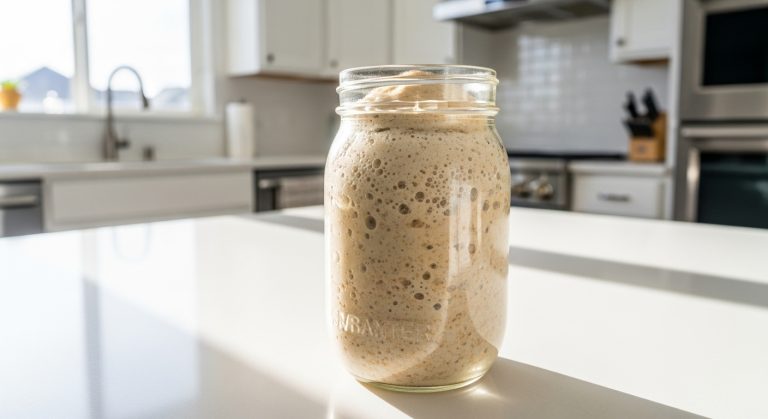
You’ll know your dough is ready when it looks all puffed up and has a nice, smooth surface. That’s a good sign that fermentation is doing its thing inside!
If you take a closer look, you might see little bubbles forming along the sides and underneath. Those pockets of gas are a clear indication that your yeast is alive and kicking!
When you give the dough a gentle press, it should feel light and airy—kind of like a marshmallow. That’s your confirmation that it’s developed the right texture to move on to the next step.
For best results, remember to perform stretch and fold techniques during bulk fermentation to strengthen the dough and improve its structure.
Puffy Dough Appearance
A puffy dough appearance signals that your sourdough has undergone sufficient fermentation during bulk.
When your dough puffs up, it’s a clear visual cue that the yeast has produced enough gas to expand the gluten network, making the dough airy and alive.
Look closely for these key signs:
- Noticeable volume increase, often around 20% to 50% rise depending on dough and temperature.
- Smooth, slightly domed surface that feels light and marshmallow-like when gently pressed.
- Dough pulling away subtly from the container edges, indicating good gas retention and structure.
Trusting these visual cues lets you know when your dough is ready for the next step.
This helps avoid over or under fermentation and assists you in achieving that perfect sourdough crumb.
Keep in mind that fermentation time significantly impacts the texture and appearance of the loaf, so monitoring it carefully is essential.
Bubble Formation Visibility
Often, the most telling sign your sourdough has reached the right point in bulk fermentation lies in the visible bubbles within the dough.
These bubbles, varying from tiny pinpricks to large pockets, reveal the carbon dioxide produced by your starter’s fermentation.
You’ll see them along the dough’s surface, sides, and sometimes underneath when using a clear container.
Their presence confirms active gas retention and gluten development, essential for a light crumb.
When bubbles are well-distributed and prominent, your dough has aerated enough to move on.
Lack of visible bubbles or only a few scattered ones means it needs more time.
Watching for these bubbles sharpens your intuition, helping you judge readiness beyond just time or volume increases.
This ensures your sourdough’s flavor and structure develop perfectly during bulk fermentation.
Dough Texture Feel
Visible bubbles indicate active fermentation, but to truly know if your dough is ready, you need to feel its texture as well as see it. When you gently press the dough, it should feel airy and slightly springy. It should never be dense or overly sticky.
This tactile feedback is essential for gauging fermentation progress beyond mere volume increase.
Look for these key texture signs:
The dough feels light and marshmallow-like, indicating good gas retention.
It offers gentle resistance, bouncing back slowly when pressed.
The surface is smooth and slightly domed, suggesting proper gluten development.
How to Use the Jiggle Test to Check Bulk Fermentation?
When you gently shake your dough container, you can quickly gauge whether the bulk fermentation has progressed enough by observing how the dough moves. A simple jiggle test can reveal its internal aeration and readiness.
You want to see a lively, wobbly motion, indicating that gas bubbles have formed and the gluten network holds them well. If the dough jiggles with a soft, marshmallow-like bounce, it’s a sign fermentation developed enough to create that light, airy structure.
Conversely, if it feels stiff or barely moves, it needs more time. The jiggle test complements visual cues like dough volume and bubble formation, giving you a tactile sense of fermentation progress.
Mastering this test helps you avoid under- or over-fermenting, ensuring your sourdough rises beautifully during bulk.
When to Stop Bulk Fermentation: Dough Texture and Elasticity Signs?
Alongside the jiggle test, paying close attention to dough texture and elasticity can guide you on when to stop bulk fermentation.
You want your dough to feel airy yet resilient, signaling optimal gluten development and fermentation progress.
When handling it gently, notice these key signs:
The dough should stretch without tearing easily, showing strong elasticity.
Look for dough that stretches smoothly without tearing, a clear sign of strong elasticity and readiness.
It should feel light and slightly springy, not dense or overly soft.
When poked, the dough slowly springs back but retains a slight indentation, indicating good gas retention without over-proofing.
These tactile clues reveal that your dough has built enough strength and fermentation gases to rise properly during proofing and baking.
Trusting these signs guarantees your sourdough reaches its peak texture, ready for shaping and the next step in your baking journey.
How Longer Bulk Ferments Influence Dough Rise and Flavor?
Although longer bulk fermentations extend your dough’s rising time, they deeply enhance both its flavor complexity and texture.
As fermentation progresses, enzymes break down starches and proteins, releasing sugars and amino acids that create richer, more nuanced flavors.
You’ll notice your dough developing a gentle tang and subtle sweetness, balanced by a more open crumb structure.
The extended rise also encourages stronger gluten development, making the dough feel lighter and more elastic.
However, you’ll want to watch carefully; too long can lead to over-fermentation, weakening the dough’s structure.
By embracing longer bulk times, you allow the natural wild yeasts and bacteria to work fully, resulting in a loaf with superior depth and aroma.
This process creates an airy, tender crumb that truly showcases the art of sourdough baking.
How to Adjust Rise Targets for Different Temperature Conditions?
Mastering the timing and extent of your dough’s rise means paying close attention to the temperature at which fermentation occurs. Warmer conditions accelerate yeast activity, so you’ll want to aim for a lower rise percentage to avoid overproofing. Conversely, cooler temperatures slow fermentation, requiring you to allow more rise to reach ideal development.
To adjust your rise targets effectively:
At around 27°C (81°F), aim for a 20%-30% rise, finishing bulk in about 4.5 to 5 hours.
Near 23°C (73.4°F), target a 50%-60% rise, extending bulk to 6-7 hours.
Below 20°C (68°F), expect close to doubling, with 12+ hours bulk time for full maturation.
Fine-tune by observing dough texture and bubbles, ensuring you’re not relying on temperature alone.
Frequently Asked Questions
Can Bulk Fermentation Rise Be Measured Without a Clear Container?
Yes, you can measure bulk fermentation rise without a clear container by relying on tactile and visual cues.
Feel your dough—it should become light, airy, and slightly domed.
Look for surface smoothing and bubbles popping beneath.
Gently jiggle it; a well-fermented dough jiggles like a soft marshmallow.
Notice if it pulls away from the container edges.
These signs tell you about fermentation progress even if you can’t see exact volume changes.
How Does Altitude Impact Sourdough Bulk Fermentation Rise?
Altitude loves to mess with your sourdough’s ego. It makes gases expand faster, so your dough might puff up quicker but also collapse if you’re not careful.
You’ll need to shorten fermentation times and watch rise closely since lower air pressure means less oxygen and weaker gluten development.
Adjust hydration and starter strength thoughtfully, or your lofty dreams might deflate. At high altitudes, precision and patience become your best baking allies.
What Tools Help Accurately Measure Dough Rise Percentage?
You’ll want a clear container marked with volume or height measurements to track dough rise percentage accurately. A ruler or measuring tape works great for precise height checks.
Some bakers use digital scales to monitor weight changes indirectly tied to fermentation. You can also use smartphone apps designed for baking logs, which let you input measurements over time.
Combining these tools helps you measure rise consistently and master your sourdough’s bulk fermentation.
Does Bulk Fermentation Rise Affect Sourdough Crust Texture?
You want a crust that’s crisp, crackling, and deeply caramelized.
Bulk fermentation rise directly impacts this by influencing dough strength, gas retention, and moisture distribution.
If your dough under-rises, expect a denser crumb and a less crackly crust.
Over-rise, and you risk a fragile crust and muted flavor.
Perfect bulk rise balances elasticity and aeration, helping you achieve that golden, textural crust that sings with every bite.
How to Troubleshoot Dough Not Rising During Bulk Fermentation?
If your dough isn’t rising during bulk fermentation, first check your starter’s strength. It might be weak or inactive.
Make sure your dough temperature is warm enough, ideally between 24°C and 28°C (75°F to 82.4°F).
Also, verify your hydration and flour type suit your recipe.
If the dough feels dense or lacks bubbles, extend fermentation time and try gentle folds to redistribute yeast and gases.
Adjust these variables to revive your rising dough.
Why Monitoring Bulk Fermentation Rise Matters for Your Best Sourdough Loaf?
Remember, “slow and steady wins the race” when it comes to sourdough bulk fermentation. You want your dough to rise about 30-50%, depending on flour, hydration, and temperature.
Pay close attention to texture and elasticity, using the jiggle test to guide you. Adjust your rise targets thoughtfully because every variable shapes flavor and crumb.
Mastering this step means unleashing your sourdough’s full potential. Patience and precision will always reward you with the perfect loaf.