
Does an Air Fryer Use More Electricity Than a Microwave? Energy Breakdown
Yes, an air fryer uses more electricity than a microwave because it generally draws 800–2200 watts compared to a microwave’s 700–1500 watts.
Air fryers also cook longer, often 15 to 60 minutes, while microwaves typically cook in under 10 minutes.
For example, cooking a potato takes about 0.80 kWh in an air fryer but only 0.20 kWh in a microwave.
If you want to understand how cooking time, appliance power, and costs compare, keep exploring how each appliance fits your needs best.
Key Takeaways
- Air fryers typically use 800–2200 watts, higher than microwaves’ usual 700–1500 watts, leading to greater instantaneous power consumption.
- Microwaves cook faster (e.g., 8 minutes for a potato) compared to longer air fryer cooking times (30–60 minutes), reducing total energy use.
- Total energy consumption of air fryers often exceeds microwaves due to longer cooking despite higher wattage, e.g., 0.80 kWh vs 0.20 kWh for a potato.
- Microwaves cost less to operate for quick tasks, typically using 10–25% of the energy a conventional oven or air fryer requires.
- Air fryers provide better texture and browning but consume more electricity, making microwaves more efficient for reheating and quick cooking.
Why Do Air Fryers Use More Power Than Microwaves?

When you compare air fryers and microwaves, you’ll notice air fryers draw substantially more power, ranging from 800 to 2200 watts, while microwaves operate between 700 and 1500 watts.
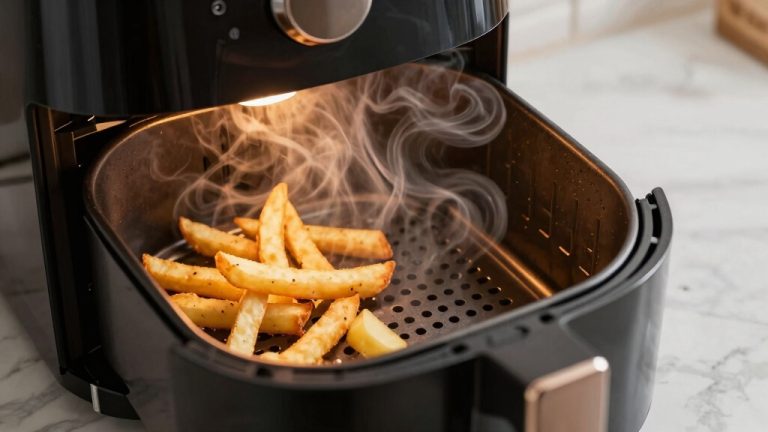
The key reason is in their heating mechanisms: air fryers rely on electric heating elements combined with fans to circulate hot air, which consumes more energy. Microwaves, however, use microwave radiation to agitate water molecules directly, heating food faster and more efficiently.
Air fryers often peak at 2200 watts during operation cycles, while microwaves rarely exceed 1500 watts.
Although air fryers provide crispy textures, their full-chamber heating results in greater power use.
Proper preheating practices can help balance energy consumption by allowing the air fryer to reach desired temperatures more efficiently.
How Cooking Time Impacts Energy Use in Air Fryers and Microwaves?
Understanding the higher power draw of air fryers sets the stage for examining how cooking time directly affects their overall energy consumption compared to microwaves.
Recognizing air fryers’ higher wattage helps reveal how cooking duration impacts energy use versus microwaves.
Air fryers operate around 1500-2200W, often cooking items like potatoes for 30 to 60 minutes. In contrast, microwaves run at 700-1500W, completing similar tasks in under 10 minutes.
For example, cooking a potato takes 60 minutes in an air fryer, consuming 0.80 kWh, while a microwave uses just 0.20 kWh in 8 minutes.
Even though air fryers have higher wattage, shorter cooking times can narrow the total energy gap.
But extended air frying markedly boosts energy use, making microwaves substantially more efficient for quick or small meals due to their rapid heating and lower power draw.
Choosing an air fryer with precise temperature control and optimized airflow can improve energy efficiency by reducing cooking time and power waste.
How Much Electricity Do Air Fryers Use Compared to Microwaves?
Electricity consumption differences between air fryers and microwaves are significant due to their power ratings and cooking durations. Air fryers typically operate at 800-2200W, while microwaves range from 700-1500W. However, cooking time largely influences total energy use.
Consider these points:
- Air fryer cooks a potato in 60 minutes (~0.80 kWh). Microwaves take 8 minutes (~0.20 kWh).
- Air fryers run fans and heating elements, increasing power draw compared to microwave radiation heating.
- Air fryer reheating uses 15-18 minutes at ~1700W (0.43-0.51 kWh). Microwaves need 5 minutes at 1000W (0.08 kWh).
- Despite higher wattage, longer air fryer cooking times cause it to consume 4x the electricity of microwaves for similar tasks.
You’ll find microwaves generally use less electricity, especially for quick meals. However, the added benefits of steam air fryers, such as moisture retention and multi-functionality, can justify their higher energy use for healthier and more versatile cooking with Steam & Crisp modes.
Which Appliance Saves You More on Your Electricity Bill?
Choosing the right appliance can markedly cut your electricity bill, and microwaves clearly lead in cost efficiency for everyday tasks.
Microwaves use less power (700-1200W) and cook faster, costing as little as 2.5p for 5 minutes. In contrast, air fryers consume 1500-2200W and cost up to 27p for longer cooking.
Although air fryers excel at certain textures, their higher wattage and longer cook times increase energy use.
Some air fryer models feature EvenCrisp technology that reduces oil use by up to 95% while delivering crispy textures, though this does not significantly lower their power consumption.
| Appliance | Power (W) | Typical Cooking Cost (p) |
|---|---|---|
| Microwave | 700-1200 | 2.5 (5 min) |
| Air Fryer | 800-2200 | 12-27 (15-60 min) |
| Mini Oven | ~2000 | 37 (potato) |
| Microwave Energy Use vs Oven | 10-25% | |
| Air Fryer vs Gas Oven Cost | 38% lower cost |
Microwaves save you more on electricity bills overall.
When to Choose an Air Fryer or Microwave for Energy Efficiency?
While microwaves generally lead in cutting costs for quick tasks, there are specific situations where an air fryer offers better energy efficiency despite higher power use.
You should weigh your choice based on cooking needs and energy consumption patterns:
- Use a microwave for quick reheating or defrosting; it consumes about 0.20 kWh for an 8-minute potato, costing less than 5p.
- Choose an air fryer for crispy fries or baking, where texture and browning matter, despite 0.75 kWh per 30-minute cook.
- For small portions, microwaves use 10-25% of oven energy, making them more efficient.
- Air fryers halve the energy cost of electric ovens but still consume more power than microwaves due to heating elements and fans.
Select based on time, texture, and energy cost trade-offs. The convection and airflow design in air fryers is crucial for delivering crisp, even results efficiently.
Frequently Asked Questions
Can Air Fryers and Microwaves Be Used Together for Cooking?
You can definitely use air fryers and microwaves together for cooking to optimize time and energy.
Use your microwave for quick tasks like defrosting or reheating, since it’s faster and more energy-efficient.
Then, finish in the air fryer to achieve crispiness and browning, which microwaves can’t deliver.
This combo balances speed and texture without wasting electricity, letting you enjoy healthier, well-cooked meals efficiently.
Are There Safety Concerns With Using Air Fryers or Microwaves?
You might be surprised, but both air fryers and microwaves have safety concerns you shouldn’t ignore.
Air fryers can overheat or cause burns if you touch hot surfaces.
Microwaves risk uneven heating and potential burns from hot spots.
Both require you to avoid metal inside.
Microwaves also risk radiation leaks if damaged.
Always follow manufacturer guidelines and never leave either appliance unattended during use to stay safe.
How Do Air Fryer and Microwave Sizes Affect Energy Consumption?
You’ll find that larger air fryers consume more energy because they heat a bigger chamber and run fans longer, increasing wattage use.
Microwaves’ size impacts energy less since they heat food directly with radiation, so even a larger microwave won’t use markedly more power.
Choosing a smaller air fryer or microwave improves efficiency, but air fryers inherently use more electricity due to longer cook times and chamber heating.
Do Different Brands of Air Fryers or Microwaves Impact Electricity Use?
Different brands can make your electricity bill dance to a different tune.
Some air fryers reach up to 2200W, while others hover around 800W, affecting power use markedly.
Microwaves vary from 700W to 1500W.
Efficiency tweaks and component quality influence actual consumption.
A high-end brand might use less energy despite similar wattage.
Always check wattage and cooking times; those details decide your true electricity cost.
What Maintenance Keeps Air Fryers and Microwaves Energy Efficient?
You keep air fryers energy efficient by regularly cleaning crumbs and grease from heating elements and fans, ensuring unobstructed airflow.
For microwaves, wipe the interior and turntable to avoid residue buildup that blocks microwaves, reducing efficiency.
Checking door seals on both prevents heat or radiation leaks.
Defrosting frozen food before cooking also saves energy.
Consistent maintenance lowers energy waste, helping your appliances perform at peak efficiency while cutting electricity use.
Save Energy and Money: When to Choose an Air Fryer or Microwave
When it comes to electricity use, air fryers generally sip more power than microwaves, like a thirsty traveler at a desert oasis.
While air fryers cook food with crispiness and flavor, they run longer, boosting energy use.
Microwaves, on the other hand, zap meals quickly, saving more electricity.
If you want to cut costs and power use, your microwave is the smarter choice.
But for crispy results, an air fryer’s worth the extra wattage.