
Best Bulk Fermentation Containers: 7 Clear Dough Tubs Sized by Batch
A good bulk fermentation container does three jobs: it gives your dough room to grow, keeps it from drying out, and shows you exactly how much it has risen. The wrong size makes all three harder. We sorted seven clear dough containers by the batch you bake, from a 2-quart tub for one small loaf to a 6-liter box for a full pizza batch.

- PROOF LIKE A PRO AT HOME – Mix, proof, and fold your dough in one container without messy ...
- EASILY TRACK DOUGH RISE – Translucent container walls and volume markings show you exactly...
- MAINTAINS HUMIDITY FOR BETTER RISES – The lid seals in moisture to keep your dough soft...
- Expert Choice
- Top Rated
- Trusted Pick
What Size Do You Need? Start With Your Batch
Dough weighs about 1 kg per liter, and it should be able to at least double without touching the lid. Find your usual batch below.
| You usually make… | Dough weight | Container size | Our picks |
|---|---|---|---|
| Starter, levain or a small loaf | Up to about 600 g | 2 quarts / about 2 L | Cambro 2 qt, GENICOOK glass |
| One standard sourdough loaf | About 850-1,000 g | 3-4 quarts | Ziliny 4 qt, SVKLHY 4 qt |
| Two loaves | About 1.7-2 kg | 6 quarts / 6 L | Cambro 6 qt, Brød & Taylor |
| A big pizza or focaccia batch | Up to 3 kg | 6 L, wide and low | Brød & Taylor |
Round, Square or Glass?
Square tubs
Straight sides make the rise easy to read, and square tubs fit fridge shelves with little wasted space.
Best for: cold retards and stacking.
Round tubs
No corners for dough to stick in, so dough tips out cleanly and coil folds are easy.
Best for: stretch-and-folds and starters.
Glass
Clear, heavy and smell-free, and it holds temperature a little longer than plastic. It can break if dropped.
Best for: small batches and watching bubbles.
What Else to Look For Besides Size
| Feature | Why it matters | Look for |
|---|---|---|
| Clear walls and markings | You judge bulk by how much the dough has grown | See-through sides with printed volume lines, or mark the start level with tape |
| A lid that seals | Uncovered dough forms a dry skin | A fitted lid you can open with one hand |
| Straight sides | In a tapered tub a 50% rise looks smaller than it is | Square or straight-walled round tubs |
| Material | Changes weight, clarity and toughness | Polycarbonate: clearest and toughest. Polypropylene: lighter, dough releases well. Glass: heavy, smell-free, can break |
| Fridge fit | Cold retards need shelf space | Measure your shelf height; square tubs waste the least room |
| Easy cleaning | Sticky dough dries hard in corners | Dishwasher-safe, with rounded inside corners |


Our 7 Containers, Spec by Spec
1. Brød & Taylor Proofing Container (6 L): Best Overall

- PROOF LIKE A PRO AT HOME – Mix, proof, and fold your dough in one container without messy towels...
- EASILY TRACK DOUGH RISE – Translucent container walls and volume markings show you exactly when...
- MAINTAINS HUMIDITY FOR BETTER RISES – The lid seals in moisture to keep your dough soft...
- Capacity
- 6 L, up to 3,000 g dough
- Material
- BPA-free polypropylene
- Shape
- Wide, low rectangle
- Lid
- Moisture-sealing
- Markings
- Volume lines
- Cleaning
- Dishwasher safe
Brød & Taylor, the maker of the popular Folding Proofer, designed this container so you can mix, fold and proof in one tub without towels or plastic wrap. Its translucent walls and volume markings show the rise without lifting the lid, and the lid seals in moisture so the dough does not form a skin. The wide base makes stretch-and-folds and coil folds easy, and two containers stack inside the Brød & Taylor Folding Proofer. Dough releases cleanly from the polypropylene, even at high hydration, and the tub is freezer friendly.
Choose it if you bake two loaves or pizza batches, do coil folds in the tub, or own a Brød & Taylor proofer.
Skip it if you only bake one small loaf at a time; the dough will spread thin in such a wide tub and the rise is harder to judge.
2. Cambro Camsquare 6 Quart: Best Large Square

- 6 qt. capacity
- Clear design
- Withstands temperatures from -40 to 160 degrees Fahrenheit
- Capacity
- 6 quarts
- Material
- Clear polycarbonate
- Shape
- Square, straight sides
- Lid
- Matching lid included
- Markings
- Quarts and liters
- Cleaning
- Dishwasher safe, NSF
Cambro containers are the restaurant standard, and the 6-quart Camsquare is a favorite of bakers who make two loaves at a time. The clear polycarbonate is crystal clear, the sides are straight so the rise is easy to read against the printed quart and liter lines, and it comes with a matching lid. Cambro rates it for -40 to 160°F and safe for the fridge, freezer and dishwasher.
Choose it if you want a tough, commercial-grade tub for two-loaf batches and overnight cold retards.
Skip it if you bake one loaf; 6 quarts is more room than a single loaf needs.
3. Ziliny 4 Quart Square Dough Container: Best for One Loaf
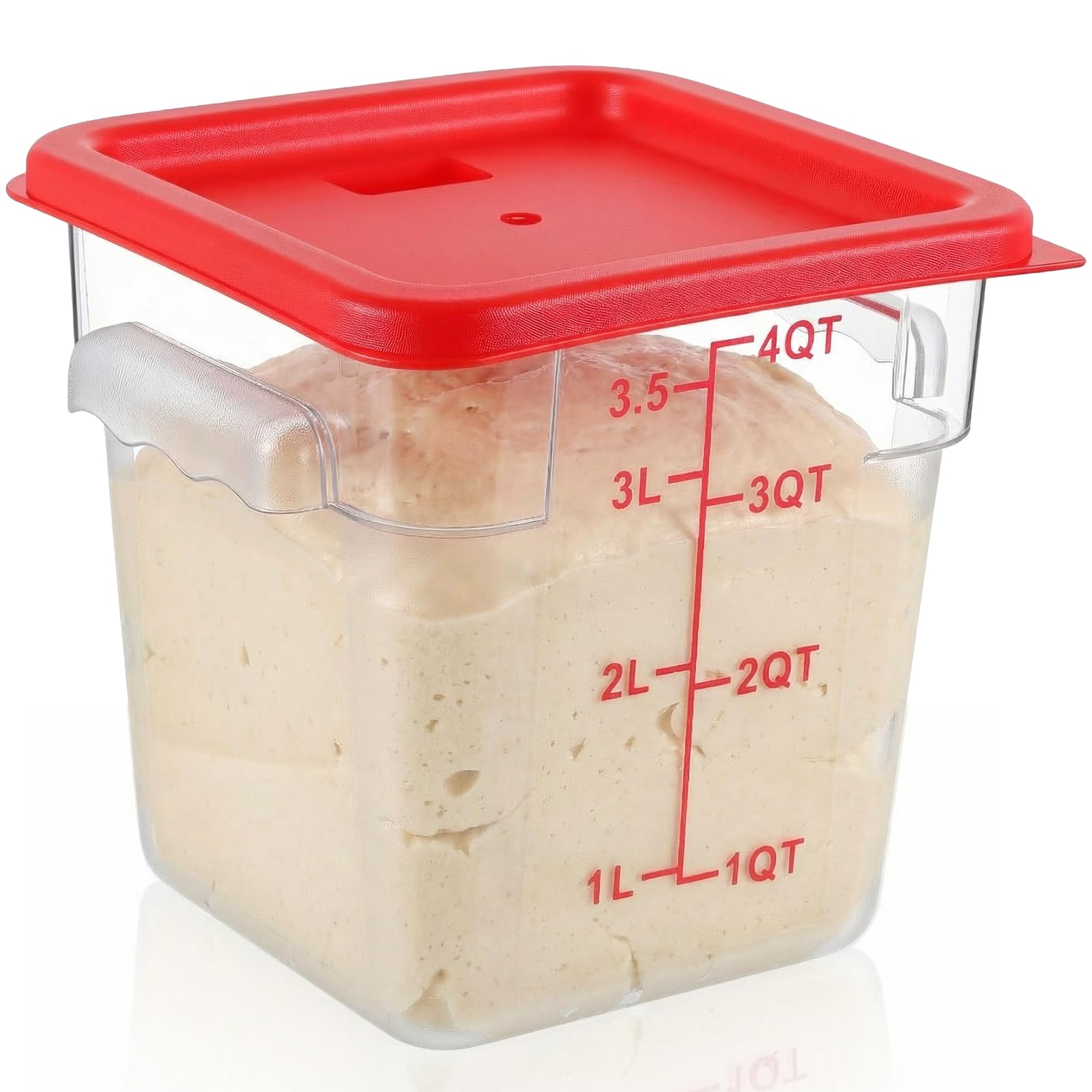
- Large Capacity: one 4 quart food container with lid, ideal for storing large amounts of food...
- Strong and Sturdy: made from durable polycarbonate, impact resistant and freezer safe, a reliable dough proofing container for everyday baking...
- Clear and Graduated: clear containers with scale and handle, so you can see what is inside and watch your dough rise...
- Capacity
- 4 quarts
- Material
- Polycarbonate
- Shape
- Square with handle
- Lid
- Fitted red lid
- Markings
- Graduated scale
- Cleaning
- Freezer safe
Four quarts is the sweet spot for a single sourdough loaf: enough room for the dough to double without pressing on the lid, and the dough still sits deep enough to read the rise. This square polycarbonate container is impact resistant and freezer safe, has a graduated scale and a side handle, and the fitted lid keeps the dough from drying out. The square shape saves space in the fridge.
Choose it if you bake one loaf at a time and want straight sides and clear markings for the bulk.
Skip it if you regularly make double batches.
4. Cambro Camwear 2 Quart Round: Best for Small Batches

- Capacity
- 2 quarts
- Material
- Clear Camwear
- Shape
- Round
- Lid
- Matching lid included
- Markings
- 1 and 2 quart lines
- Cleaning
- Commercial grade
A 2-quart round Cambro is a handy size for a levain, a small loaf, or half a batch of pizza dough, and many bakers keep their starter in one. The clear Camwear body shows the bubbles from the side, the round shape has no corners for dough to stick in, and it comes with a matching lid.
Choose it if you bake small loaves, rolls or levain builds, or want a sturdy starter home.
Skip it if you bake a full 900 g loaf; it will reach the top once the dough doubles.
5. Ziliny 2 Quart Dough Containers (2 Pack): Best Value Pair
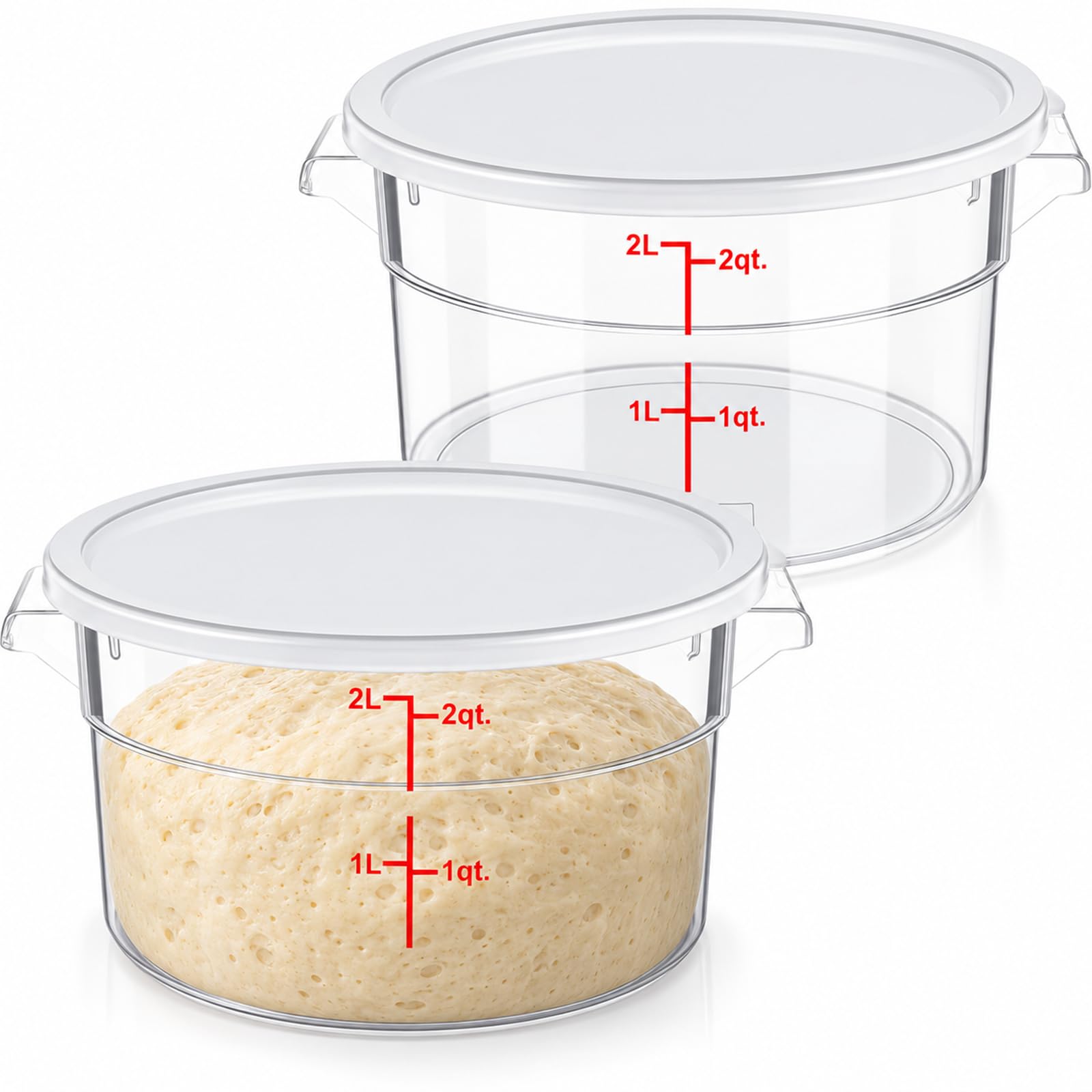
- Sturdy Food-grade Durability: our food grade dough proofing container with lid is constructed from polycarbonate; shatter-resistant and not easy to crack...
- Clear and Graduated: these proofing bowls with measurements are clear and have a graduated design, so you can see the contents without opening them...
- Large Capacity: a set of two 2-quart dough buckets with lids, ideal for storing food and fermenting dough...
- Capacity
- 2 × 2 quarts
- Material
- Polycarbonate
- Shape
- Round
- Lid
- Sealing lids
- Markings
- Red graduated scale
- Cleaning
- Stackable
Two round 2-quart polycarbonate tubs with sealing lids and an easy-to-read red scale. They are shatter resistant, stack to save space, and are a good way to split a batch: one tub for the starter, one for a small dough, or two half-batches of pizza dough fermenting side by side.
Choose it if you want two small tubs for starter plus dough, or split pizza batches.
Skip it if you need one container for a full loaf.
6. SVKLHY 4 Quart Containers (4 Pack): Best Multi-Pack

- 【FOOD STORAGE CONTAINER SET】: SVKLHY clear food container package includes 4*4qt square food...
- 【CLEAR & DURABLE MATERIAL 】: The material of commercial food container is super transparent...
- 【SAFE & ENVIRONMENTALLY FRIENDLY】: Square food containers with lids is NSF certified, ensuring...
- Capacity
- 4 × 4 quarts
- Material
- Clear, NSF certified
- Shape
- Square
- Lid
- Red lids
- Markings
- Quart lines
- Cleaning
- Stackable
If you bake several doughs at once, or want matching tubs for flour and grains too, this set gives you four 4-quart square containers with red lids, plus 8 labels, a marker and 2 measuring cups. The containers are NSF certified, the seller says they are free of BPA, and they are rated for -40 to 250°F. Use the labels to note the start time and the starting level of each dough.
Choose it if you bake several loaves or doughs a week and want one size for everything.
Skip it if you only need a single container.
7. GENICOOK Borosilicate Glass Set: Best Glass
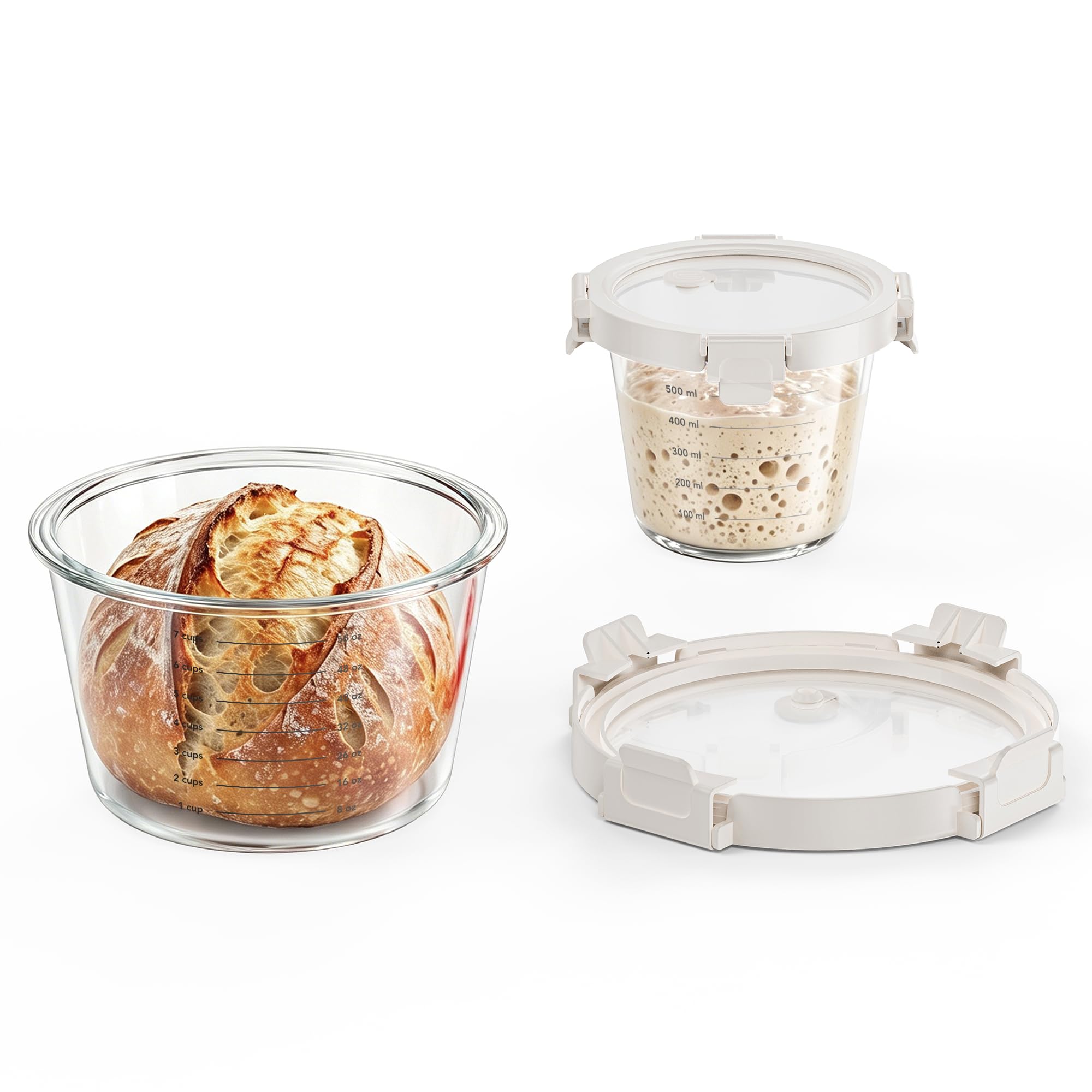
- 【VERSATILE GLASS CONTAINERS FOR SOURDOUGH BREAD,BAKING & KITCHEN PREP】From feeding sourdough...
- 【2 PERFECT SIZES FOR STARTER FEEDING, DOUGH MIXING & PROOFING】The 24oz container is ideal for...
- 【AIRTIGHT LIDS KEEP STARTER FRESH & REDUCE MESS】Each container includes a BPA-free airtight lid...

- Capacity
- 24 oz + 71 oz
- Material
- Borosilicate glass
- Shape
- Round, wide mouth
- Lid
- Airtight, silicone seal
- Markings
- Measuring marks
- Cleaning
- Dishwasher safe
For bakers who prefer glass, this set pairs a 24-ounce jar for the starter with a 71-ounce container for mixing and proofing a small dough. Both are borosilicate glass, which copes with temperature changes better than standard glass, with measuring marks and airtight lids with a silicone seal. The glass is safe in the microwave, oven (without the lid), fridge and dishwasher, and does not hold smells.
Choose it if you want a matching starter jar and a small glass proofing container.
Skip it if you bake full-size loaves; 71 ounces (about 2.2 quarts) is a small-batch size.
How to Read the Rise in Your Container
Recipes often say “bulk until the dough has risen 50%” or “until it has doubled.” A straight-sided, marked container turns that into a number you can see.
- Mark the start. After the last mix, press the dough level and mark its height with tape or a dry-erase marker, or note the volume line it reaches.
- Work out the target. If the dough starts at the 1-quart line, a 50% rise is 1.5 quarts and a doubling is 2 quarts.
- Check the sides and top. Look for bubbles against the side of the tub, a domed, jiggly surface and a few bubbles on top.
- Account for temperature. Warm dough gets there faster; at cooler room temperatures the same rise can take hours longer.
Our guide to how much sourdough should rise during bulk fermentation goes deeper, and overproof vs underproof sourdough shows what each looks like.
Common Mistakes With Bulk Containers
- Too big a tub for the batch: the dough spreads out flat and barely seems to rise, so it is easy to over-ferment.
- Too small a tub: the dough presses on the lid, and you have to guess when it has doubled.
- Curved mixing bowls: fine for mixing, but the rise is hard to judge. Move the dough to a straight-sided tub for the bulk.
- A cold counter in winter: a cold kitchen slows the bulk a lot. A sourdough heating mat or a proofing box keeps the dough at a steady temperature.
Questions Bakers Ask
What size container do I need for bulk fermentation?
Choose a container that holds at least twice, and ideally three times, the volume of your dough when you start. For one standard sourdough loaf (about 900 g of dough) a 3- to 4-quart container is comfortable; for two loaves, use 6 quarts.
Dough weighs roughly 1 kg per liter, so 900 g of dough fills about 1 quart at the start and 2 quarts once it has doubled. A 2-quart container works for one loaf only if you stop the bulk before the dough doubles.
Is a plastic or glass container better for bulk fermentation?
Both work. Clear plastic tubs are light, unbreakable and usually have printed volume lines, which makes tracking the rise easy. Glass looks good, is easy to see through and does not hold smells, but it is heavier and can break.
Plastic changes temperature faster, glass holds it a little longer. Either way, what matters most is straight sides and markings you can read. We cover this in more detail in can you proof sourdough in a plastic bowl.
Why do bakers prefer straight-sided containers?
In a straight-sided container, the height of the dough rises in step with its volume, so a 50% rise in volume shows as a 50% rise on the side of the tub. In a curved bowl the dough spreads out as it rises and the rise is hard to judge.
That is why most sourdough recipes that give a percentage rise for bulk fermentation assume a square or round tub with vertical walls.
Does the lid need to be airtight?
No. The lid is there to keep the dough from drying out and forming a skin, not to seal it. A snap-on lid is fine for a few hours of bulk fermentation at room temperature.
Dough gives off carbon dioxide as it ferments. If a tight lid starts to dome during a long cold ferment, open it briefly, or leave one corner unsnapped.
Can I put my bulk fermentation container in the fridge?
Yes. Every container in this guide can go in the fridge, so you can do a cold bulk or retard the dough overnight in the same tub. Square containers make better use of fridge shelf space than round ones.
Our guide to cold proofing sourdough explains timings and temperatures.
How do I stop dough sticking to the container?
Lightly oil the inside of the container, or wet your hands and a dough scraper before you tip the dough out. A thin film of oil is enough; too much makes the dough slide when you shape it.
Smooth polypropylene and glass release dough more easily than scratched plastic, so wash containers by hand or on the top rack and avoid abrasive scourers.
How We Chose
We compared containers bakers actually use for bulk fermentation: commercial food tubs, purpose-made dough containers and glass, and sorted them by batch size, shape, material, lid and markings. Every container here could be ordered on Amazon for US delivery when this guide was updated in November 2026, and the details come from the makers’ listings. Prices change often, so we do not list them; the buttons show the current price on Amazon. For background on fermentation and proofing, see Wikipedia’s article on proofing.

Keep Reading
Last update on 2026-11-26 / Affiliate links / Images from Amazon Product Advertising API