
Best Bread Slicers for Sourdough: 8 Slicers and Knives Compared
A good sourdough loaf has a crackly crust and a soft, open crumb, and an ordinary kitchen knife tends to crush one while it fights the other. The right tool fixes that: a hand-crank slicer for identical sandwich slices, a bow knife for quick slicing by hand, or a long serrated knife that does everything. We compared eight bread slicers and knives that are easy to buy today so you can pick the right one in a couple of minutes.
What Is the Best Bread Slicer for Sourdough?
For most home bakers, the Brvclon Manual Bread Slicer is the best choice: its hand crank and thickness dial cut even slices from 0 to 0.9 inch, and suction feet hold it steady on crusty loaves. If you would rather slice by hand, the Mercer Millennia 10-inch bread knife is the best low-cost option for big boules.

- Adjustable Thickness: This manual bread slicer offers 0–0.9" adjustable thickness for thic...
- Easy to Use & Maintain: The compact size of this sourdough bread slicer saves valuable kit...
- Premium Quality: The hand crank bread slicer is crafted with a sturdy solid wood base and ...
- Expert Choice
- Top Rated
- Trusted Pick
Which Type of Bread Slicer Is Right for You?


Quick Comparison
| Tool | Type | Slice control | Best for |
|---|---|---|---|
| Brvclon | Hand-crank slicer | Dial, 0 to 0.9 in | Even slices of every loaf |
| Mercer Millennia | 10 in serrated knife | By hand | A budget all-rounder |
| TYOARO | Bow knife, cherry wood | By hand, straight guide frame | Crusty loaves straight from the oven |
| Zassenhaus | Hand-crank slicer | Dial, up to 0.7 in | A classic German slicer for the counter |
| ROYOROYI | Bow knife, beech wood | By hand, 10.8 in blade | Big round boules |
| Victorinox Fibrox | 10.25 in serrated knife | By hand | A knife that lasts for decades |
| ABIOTO | Folding slicing guide | Slots, 3/8 to 1 in | Even slices with the knife you own |
| Elite Gourmet EK9810 | Cordless electric knife | By hand, powered blades | Slicing several loaves at once |
Our 8 Picks in Detail
1. Brvclon Manual Bread Slicer: Best Overall

- Adjustable Thickness: This manual bread slicer offers 0–0.9" adjustable thickness for thick toast...
- Easy to Use & Maintain: The compact size of this sourdough bread slicer saves valuable kitchen...
- Premium Quality: The hand crank bread slicer is crafted with a sturdy solid wood base and sharp...

A hand-crank slicer takes the guesswork out of slicing: you set the thickness, turn the handle and guide the loaf into a round serrated blade. The Brvclon adjusts from paper-thin up to 0.9 inch with a printed scale, sits on a solid wood base held down by suction cups, and has a removable, replaceable stainless steel blade. It handles hard-crusted sourdough as well as soft sandwich bread and bagels, and the maker offers a 3-year warranty (see the listing for terms).
Best for: Bakers who slice a loaf most days and want every slice the same, from toast to thick sandwich bread.
- Thickness dial with a clear scale
- Works on crusty and soft breads
- Suction feet keep it steady
- Replaceable blade; 3-year maker’s warranty
- Takes counter or cupboard space
- Very tall boules may need halving first
- Round blades need careful cleaning
2. Mercer Culinary Millennia 10-Inch Bread Knife: Best Budget

- QUALITY CONSTRUCTION: Knife is crafted with one-piece high-carbon Japanese steel for easy edge...
- SUPERIOR DESIGN: Built to last ergonomic handle with textured finger points offers a non-slip grip...
- BEST USE: The teeth on the wavy edge of the knife's blade easily slice through foods' crust or skin...
A favourite in culinary schools, the Mercer Millennia is a 10-inch knife with a wide wavy edge made from one-piece high-carbon Japanese steel. The wavy teeth bite through a hard crust without tearing the soft inside, and the textured handle stays secure in a floury hand. It is just as useful for cakes, tomatoes and meatloaf.
Best for: Home bakers who want one dependable serrated knife without spending much.
- Long blade covers wide boules
- Grippy, comfortable handle
- Good for cakes, fruit and tomatoes too
- Easy to store in a drawer or block
- No guide, so straight slices take practice
- Hand wash only
- Plain black handle, not a showpiece
3. TYOARO Cherry Wood Bow Knife: Best for Crusty Loaves
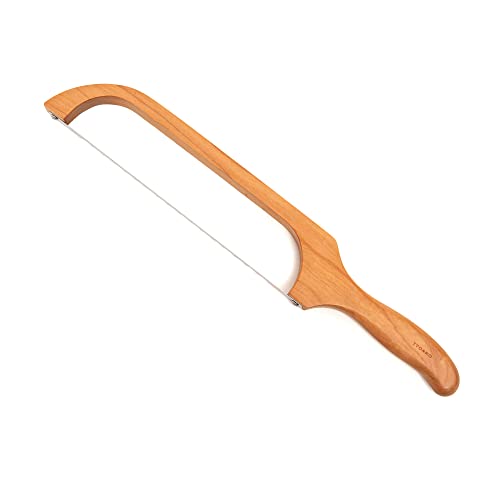
- Stop Crushing Bread: Specially designed for ideal weight distribution, our bow bread knife...
- Thin, Even Slices: From sandwiches to French toast, our bread knife cuts straight slices up to...
- Endless Versatility: Measuring 16 1/4" long and 2 3/8" wide with a 9” cutting length, our wooden...
A bow knife holds a long serrated blade in a wooden frame, and the frame works as a guide: keep it level with the board and your slices come out straight. The TYOARO is made from North American cherry wood with a 9-inch cutting length, cuts slices up to about 1 7/8 inches thick, and uses a deep scalloped edge that needs only a light sawing motion. A reusable blade guard is included.
Best for: Anyone who slices a sourdough loaf by hand a few times a week and wants straighter slices than a normal knife gives.
- Frame keeps slices straight
- Light sawing motion, little crushing
- Handsome cherry wood
- Blade guard for safe storage
- Right-handed design
- Hand wash and dry only
- The blade cannot be resharpened like a chef’s knife

4. Zassenhaus Classic Bread Slicer: Best Classic Design

- CLASSIC BREAD SLICER FOR HOMEMADE BREAD: Baking homemade bread is more popular than ever! And...
- SUPERIOR GERMAN DESIGN: If you want a precision tool for slicing and cutting homemade bread in your...
- ADJUSTABLE & CONVENIENT: This manual cutter will impress you with its highly adjustable design that...
Zassenhaus has made kitchen tools since 1867, and this crank slicer looks the part with a wood base and a coloured steel housing. Its serrated stainless steel blade is made in Solingen, Germany, a dial sets slices up to about 0.7 inch, and four suction cups hold it in place. It comes in several colours.
Best for: Bakers who want a crank slicer that also looks good left out on the counter.
- German-made serrated blade
- Simple thickness dial
- Suction cups for stability
- Several colours
- Thickest setting is a little thinner than the Brvclon’s
- Wipe clean only
- Heavier to move around
5. ROYOROYI Beech Wood Bow Knife: Best for Big Boules

- CLEAN, EVEN SLICES: This sourdough knife for slicing crusty homemade loaves pairs a serrated blade...
- SHARP 420 STAINLESS STEEL BLADE: The serrated edge saws smoothly through firm sourdough crusts...
- THICK BEECH WOOD BOW: Solid beech wood gives the bread bow knife a stable, comfortable grip. The...
The ROYOROYI has a longer 10.8-inch blade of 420 stainless steel in a thick beech wood bow, about 16 inches overall. The extra length helps with large round boules and long batards, and the rigid frame keeps the blade aligned as you saw through a thick crust.
Best for: Bakers who make large loaves and want a bow knife with a longer blade.
- Long blade for wide loaves
- Stiff beech frame
- Also good for baguettes and bagels
- Right-handed design
- Hand wash and dry
- Takes more drawer space than a knife
6. Victorinox Fibrox 10.25-Inch Bread Knife: Best Long-Term Knife
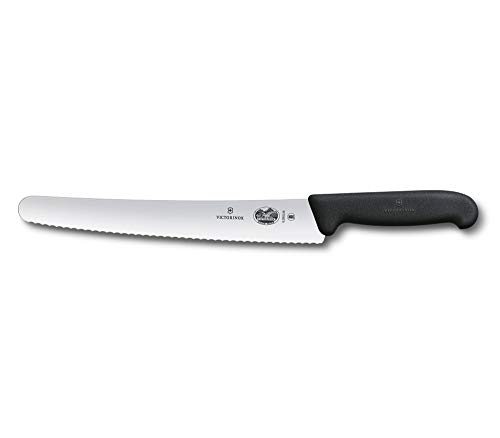
- A COUNTERTOP ESSENTIAL: As the master of your kitchen, you deserve the right tools to express your...
- FIT FOR ALL TASKS: Victorinox kitchen knives are dexterous, ergonomic and universally adaptable...
- EASY HANDLING: Inspired by our Fibrox Pro line, we've designed a contemporary, Swiss Classic...
Made in Switzerland, the Victorinox has a 10.25-inch serrated, ice-tempered stainless steel blade and the slip-resistant Fibrox handle used in professional kitchens. It is designed to get through crusty exteriors without crushing the inside, and Victorinox offers a lifetime guarantee against defects in material and workmanship (see the listing for terms).
Best for: Anyone who wants a bread knife to keep for many years.
- Swiss-made, professional standard
- Non-slip handle even when wet
- Maker’s lifetime guarantee against defects
- Long, thin blade
- No guide for straight slices
- Hand washing recommended
7. ABIOTO Folding Slicing Guide: Best Add-On for Your Knife

- Compact Design: This bread slicing guide for homemade bread is easy to clean, folds flat for...
- Even and Consistent Slices: Slice with our sourdough bread slicer like a pro and impress your closed...
- Slices of All Sizes: From 3/8” thin slices to 1” thick cuts, our bamboo bread slicer handles it...
A slicing guide is a frame with slots that keeps your knife straight, so it turns any long bread knife into a precise slicer. The ABIOTO has a food-safe HDPE base and hard maple guides, offers slices from 3/8 inch to 1 inch, has two stop boards to hold the loaf, and folds flat for storage. It works best with a blade of about 9 inches or longer, such as the Mercer or Victorinox above.
Best for: Bakers who already own a good bread knife and want even slices without a crank slicer.
- Even slices with the knife you have
- Folds flat
- Non-slip feet
- HDPE base resists wood shavings
- Needs a long knife
- Tall loaves can stand higher than the guides
- Slower than a crank slicer
8. Elite Gourmet EK9810 Cordless Electric Knife: Best for Big Batches

- RECHARGEABLE CORDLESS HANDLE – Removable recharging cable allows easy access around the kitchen...
- FOUR STAINLESS STEEL BLADES - This electric knife features two sets of reciprocating, serrated...
- MULTIPURPOSE USE - Perfect for slicing meats, great for breads. Easily carve through everything from...
If you bake several loaves at a time, or slice a whole loaf for the freezer, a powered knife saves effort. The Elite Gourmet EK9810 is cordless and rechargeable: about 1.5 hours of charging gives up to 70 minutes of use. It comes with two sets of reciprocating serrated blades and a safety trigger that stops the blades when you let go.
Best for: Batch bakers and anyone who finds sawing through hard crusts tiring.
- No cord to work around
- Very little effort on hard crusts
- Two blade sets
- Also carves meat and roasts
- Needs charging
- Slices are only as straight as your hand
- Louder than a manual knife
What to Look for in a Bread Slicer for Sourdough?
Sourdough is harder to slice than store-bought bread: the crust is thick and crisp, the crumb is soft and often open, and homemade loaves come in every shape. These six points decide whether a slicer or knife copes with that.
Blade Type and Length
There are three blade types. Round serrated blades on crank slicers spin through the loaf and give the most even slices. Straight serrated or wavy blades on bread knives and bow knives saw through the crust; the wavy edge on knives like the Mercer bites without tearing the crumb.
Length matters more than most people expect: a blade should be about 2 inches longer than your widest loaf, so for a typical 8-inch boule look for 10 inches or more. Short blades force you to saw from both sides, which leaves a ridge in the middle of each slice.
Slice Thickness Control
Crank slicers use a dial or a sliding stop: the Brvclon goes up to 0.9 inch, the Zassenhaus to about 0.7 inch. A slicing guide like the ABIOTO gives fixed slots from 3/8 to 1 inch. With a knife or bow knife, thickness is down to your eye.
If you want toast that fits the toaster every morning, choose a dial or a guide. For rustic slices of different sizes, a knife is enough.
Materials and Build
Look for stainless steel blades: they resist rust from damp crumb. Bow knife frames are usually hardwood such as cherry or beech, which is pleasant to hold but needs hand washing and the occasional oiling. Crank slicers sit on a wood or plastic base; a heavy base is steadier.
Slicing guides made from a plastic (HDPE) base with hardwood fingers, like the ABIOTO, shed fewer splinters than all-bamboo guides and are kinder to the knife edge.
Stability and Safety
A slicer that slides around is a slicer that cuts fingers. Crank slicers should have suction feet or rubber pads, and a guard or holder that keeps your hand away from the blade. Bow knives and serrated knives should come with a blade guard for the drawer.
Electric knives such as the Elite Gourmet stop as soon as you let go of the trigger, which is the feature to check on any powered model.
Loaf Size and Shape
Measure your usual loaf before you buy. Very tall boules may not fit under a crank slicer’s blade or between the fingers of a slicing guide, so halve them first. Long batards and baguettes are easiest with a 10-inch or longer knife.
Storage and Handedness
Crank slicers and guides need cupboard or counter space; knives fit in a drawer or block. Most bow knives are built for right-handed use, so left-handed bakers are better served by a straight serrated knife or a crank slicer.
How to Slice Sourdough Without Squashing It?
Even the best tool struggles with a loaf that is still warm: the crumb is still setting, so it turns gummy and tears. Let sourdough cool on a wire rack for at least an hour, ideally two, before cutting. Slice with long, light strokes and let the teeth do the work instead of pressing down. Our step-by-step guide on how to slice sourdough bread covers boules, batards and very crusty loaves.
Slice only what you need and keep the rest of the loaf cut-side down on the board, or store it in a bread bag or bread box. King Arthur Baking has a good guide to storing sourdough so it stays fresh. If you will not finish the loaf in a few days, slice it all and freeze the slices so you can toast them straight from the freezer.
Caring for Your Bread Slicer or Bread Knife
Crank slicers: turn the thickness dial to zero before cleaning, so the guide plate shields as much of the blade as possible. Brush crumbs out of the base after each use and wipe the blade with a damp cloth, moving away from the edge. Dry it at once. Brvclon’s blade lifts out for cleaning and can be replaced when it dulls.
Bread knives and bow knives: wash by hand with warm soapy water, dry straight away and store with the blade guard on. Dishwashers dull serrated edges and crack wooden frames. Rub wooden bows, handles and slicer bases with food-safe mineral oil every month or two so the wood does not dry out.
Sharpening: serrated blades stay sharp for years in home use. When they do dull, a tapered ceramic rod sharpens them one tooth at a time, or a knife shop can do it. Some bow knife blades cannot be resharpened and are replaced instead.
Frequently Asked Questions
Is a bread slicer worth it for sourdough?
Yes, if you slice a loaf most days. A crank slicer or a slicing guide gives even slices that toast evenly, fit the toaster and make neat sandwiches, which is hard to do by hand with a crusty, open-crumb loaf.
If you bake once a week or less, a bow knife or a good serrated knife does the same job in much less space. A crank slicer earns its counter space when you bake often, slice a whole loaf for the freezer, or want every slice the same thickness.
What is the best knife for cutting sourdough?
A serrated knife of 10 inches or more, or a bow knife, is best for sourdough, because the teeth cut through the hard crust instead of crushing the soft crumb underneath.
Wavy or scalloped edges like the Mercer’s grip the crust without tearing it, and a long blade lets you finish each slice in long strokes instead of sawing from both sides. We compare more options in our guides to the best sourdough bread knives and best serrated bread knives.
Is a bow knife better than a regular bread knife?
A bow knife is better for straight, even slices, because its frame keeps the blade at a fixed height and acts as a guide while you cut.
A regular serrated knife is more versatile: it is easier to store, cuts cakes, tomatoes and sandwiches as well as bread, and works for left-handed bakers, while most bow knives are made for right-handed use. If you only ever slice bread, the bow knife wins; for one knife that does everything, choose a serrated one.
Can a manual bread slicer cut soft sandwich bread?
Yes. Crank slicers with a serrated round blade cut soft sandwich bread, brioche and pan loaves as well as crusty sourdough, because the spinning blade cuts without pressing down on the loaf.
Very soft, fresh bread slices most cleanly once it has cooled completely, ideally for a few hours. Set a slightly thicker slice for soft bread, as thin slices of a very tender crumb can tear.
How thick should sourdough slices be?
About 1/2 inch is the best thickness for sandwiches and everyday toast: thick enough to hold fillings and stay soft inside, thin enough to toast through.
Go thicker, 3/4 to 1 inch, for French toast, garlic bread or slices to serve with soup, and thinner, about 3/8 inch, for crostini or tea sandwiches. A crank slicer’s dial or a slicing guide’s slots keep the same thickness from the first slice to the last.
How do you clean a bread slicer?
Clean a bread slicer by brushing out the crumbs and wiping the blade with a damp cloth, moving away from the edge, then drying it at once so the steel does not spot.
On a crank slicer, turn the thickness dial to zero first so the guide plate shields as much of the blade as possible. Never put wooden parts in the dishwasher, and rub them with food-safe mineral oil now and then. Our care section above covers knives and bow knives too.
Can you sharpen a serrated bread knife?
Yes. A serrated bread knife can be sharpened with a tapered ceramic rod, working one tooth at a time on the bevelled side, or by a knife shop that handles serrated edges.
In home use a good serrated blade stays sharp for years, because only the tips of the teeth touch the board. Some bow knife blades and cheaper knives cannot be resharpened well and are replaced rather than sharpened.
Are electric bread slicers better?
Electric knives are better only when you slice a lot of bread: they save effort on hard crusts and on many loaves, but they do not keep slices straight on their own.
For one or two loaves a week, a manual crank slicer or a good bread knife gives neater slices for less money and no charging. For a dedicated machine, see our guide to electric bread slicers.
How We Picked
We started from the slicers and knives home bakers buy most for sourdough, kept only products that were in stock on Amazon when this guide was updated, and compared them on blade length and type, slice control, stability, cleaning and storage. Product details come from the makers’ listings. Warranties and guarantees are the makers’ own; check the Amazon listing for current terms. We do not list prices because they change often; the buttons show the current price on Amazon. The first mechanical bread slicer was invented by Otto Rohwedder in the 1920s, and home crank slicers such as the Zassenhaus still work on the same idea.

Related Guides
Last update on 2026-11-23 / Affiliate links / Images from Amazon Product Advertising API