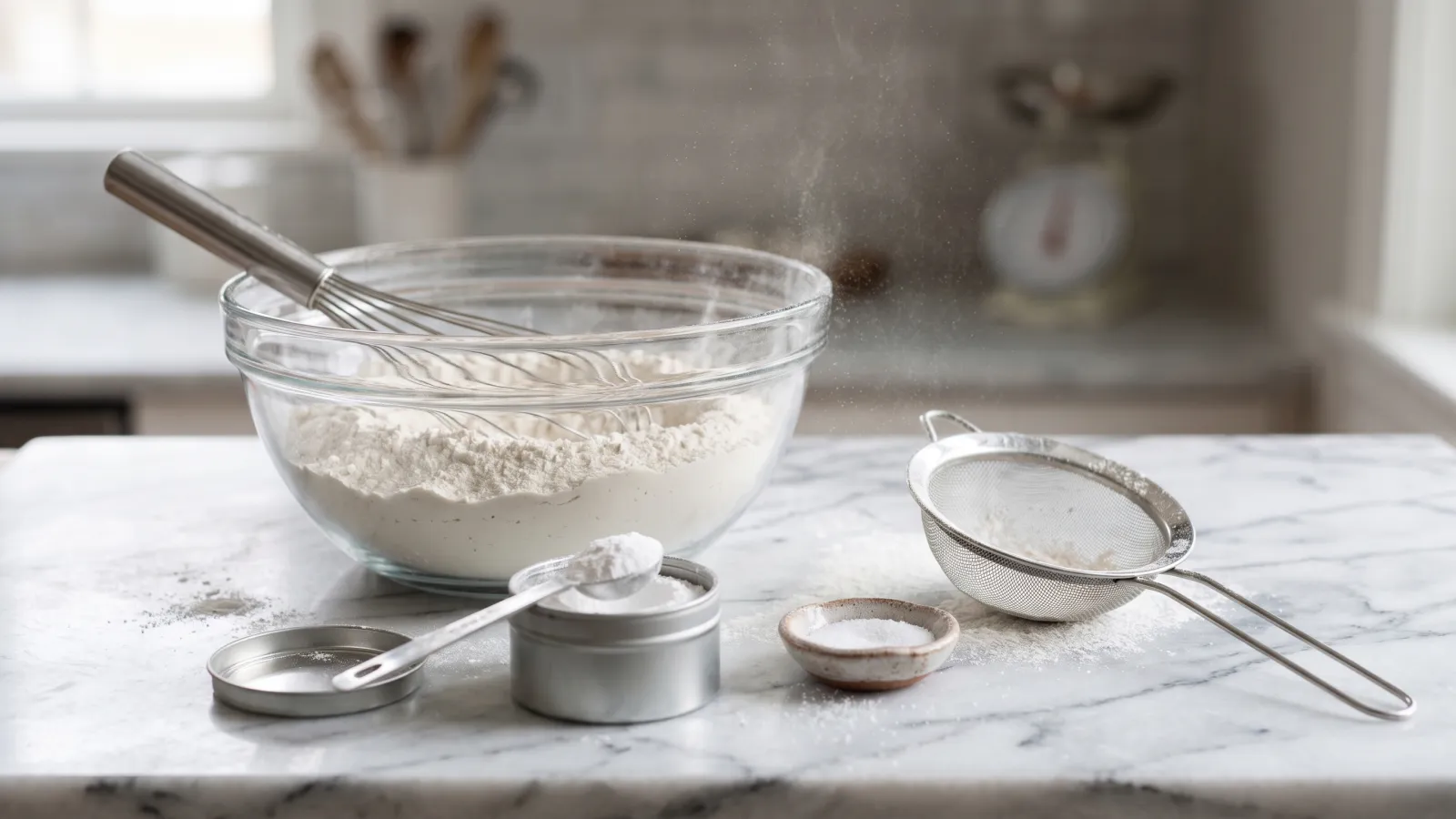
How to Make Self Rising Flour at Home (2 Ingredients Plus Salt)
Here is how to make self rising flour: for every 1 cup (120 g) of all purpose flour, whisk in 1½ teaspoons of baking powder and ¼ teaspoon of fine salt. Whisk or sift for at least 30 seconds so the baking powder is spread evenly, then use it cup for cup in any recipe that calls for self rising flour. It takes about a minute and works just like the store-bought bag.
Below you’ll find a chart for larger batches, what self rising flour is, how it differs from all purpose flour, which recipes it suits and how long a homemade batch keeps.
Key Takeaways
- 1 cup all purpose flour + 1½ tsp baking powder + ¼ tsp salt = 1 cup self rising flour.
- Whisk or sift thoroughly; uneven mixing leaves bitter spots and lopsided rise.
- Use fresh, double-acting baking powder for the best lift.
- Self rising flour suits biscuits, pancakes, muffins and quick breads, not yeast bread.
- A homemade batch keeps about 3 to 6 months in an airtight container, as long as the baking powder is fresh.
What Is Self Rising Flour?
Self rising flour is a low-protein white flour with baking powder and salt already mixed in. It was made popular in the American South for biscuits and quick breads: the leavening is measured for you, so you only add fat and liquid. Store brands such as White Lily use soft winter wheat, which gives especially tender biscuits.
Because the leavening is built in, recipes written for self rising flour do not list baking powder or salt, or list only a little. That is why you cannot simply use plain flour in their place without adding them yourself.
Homemade Self Rising Flour Ratio Chart
The ratio stays the same however much you make. Scale it with this chart.
| All purpose flour | Baking powder | Fine salt | Makes |
|---|---|---|---|
| ½ cup (60 g) | ¾ tsp | ⅛ tsp | ½ cup |
| 1 cup (120 g) | 1½ tsp | ¼ tsp | 1 cup |
| 2 cups (240 g) | 1 tbsp | ½ tsp | 2 cups |
| 3 cups (360 g) | 1½ tbsp | ¾ tsp | 3 cups |
| 4 cups (480 g) | 2 tbsp | 1 tsp | 4 cups |
Some bakers prefer 2 teaspoons of baking powder per cup for an extra-tall biscuit. Start with 1½ teaspoons; more than 2 teaspoons can taste metallic.
How to Make Self Rising Flour Step by Step?
You need only a bowl, a whisk and measuring spoons. The steps below make one cup; multiply for more.
Step 1: Measure the Flour
Spoon all purpose flour into a measuring cup and level it with a knife, or weigh 120 g. Scooping straight from the bag packs the flour and can add 20 to 30 g, which changes how the recipe bakes.
Step 2: Add Baking Powder and Salt
Add 1½ teaspoons of baking powder and ¼ teaspoon of fine salt. Use table salt or fine sea salt; coarse kosher salt doesn’t spread as evenly.
Step 3: Whisk or Sift Well
Whisk for 30 seconds, or sift the mixture twice. This is the step that matters most: baking powder that clumps in one spot leaves bitter pockets and uneven rise.
Step 4: Use or Store
Use it right away in place of self rising flour, cup for cup. To store it, see the section on shelf life below.
Can You Make Self Rising Flour With Bread Flour or Other Flours?
You can, but the result changes. Self rising flour is meant to be soft and tender.
- All purpose flour is the best base. Unbleached or bleached both work.
- Bread flour makes chewier, less tender biscuits and pancakes because of its higher protein. If it is all you have, replace 2 tablespoons per cup with cornstarch. Our guide to bread flour vs all purpose flour explains why.
- Cake or pastry flour makes a very soft, close match to Southern self rising flour.
- Whole wheat flour works for half the flour; add 1 to 2 tablespoons extra liquid to the recipe.
- Gluten-free: use a gluten-free all purpose blend with xanthan gum; see how to make gluten free self rising flour.
Self Rising Flour vs All Purpose Flour
| Self rising flour | All purpose flour | |
|---|---|---|
| Contains | Flour, baking powder, salt | Flour only |
| Protein | Usually lower (about 8 to 9% in Southern brands) | About 10 to 12% |
| Best for | Biscuits, pancakes, muffins, quick breads, dumplings | Everything, including yeast bread |
| Shelf life | Shorter (the baking powder weakens) | Longer |
| Swap | Needs no extra leavening | Add 1½ tsp baking powder + ¼ tsp salt per cup |
To use self rising flour in a recipe that calls for all purpose flour, leave out the recipe’s baking powder and salt. If the recipe uses baking soda with an acidic ingredient such as buttermilk, keep the baking soda.
What Can You Make With Self Rising Flour?
Self rising flour shines in quick bakes leavened by baking powder.
- Biscuits: the classic use. Two cups of self rising flour, ½ cup cold butter and about ¾ cup buttermilk make a batch of tender biscuits.
- Pancakes and waffles: fluffy with no extra baking powder.
- Muffins and quick breads: banana, zucchini and pumpkin loaves.
- Dumplings, cobbler toppings and scones.
- Cakes: many simple cakes work, such as this pound cake using self rising flour.
Avoid it in yeast bread: the baking powder isn’t needed, the salt throws off the recipe, and the soft flour makes a weak dough.

How Long Does Homemade Self Rising Flour Last?
The flour itself keeps for months; the baking powder is what fades. Store homemade self rising flour in an airtight container in a cool, dry cupboard and use it within 3 to 6 months, or by the date on your baking powder, whichever comes first. Label the jar with the date.
To check whether it still has lift, stir 1 teaspoon of the mix into a little hot water. Fresh baking powder fizzes right away. If nothing happens, add fresh baking powder to the next batch. Our best aluminum-free baking powder guide covers brands without the metallic aftertaste some people notice.
What Is the Difference Between Self Rising and Self Raising Flour?
They are the same idea under two names. “Self rising” is the American term, “self raising” the British one. UK self raising flour usually has a little more baking powder and often no salt, so if you follow a British recipe, add a pinch of salt if it seems bland.
Which Self Rising Flour Method Should You Choose?
For almost every recipe, mix all purpose flour with 1½ teaspoons of baking powder and ¼ teaspoon of salt per cup right before baking. If you make Southern-style biscuits often, use soft cake or pastry flour as the base for the most tender result. Make only what you’ll use in a few months so the baking powder stays strong.
Frequently Asked Questions
How much baking powder do I add to 1 cup of flour to make it self rising?
Add 1½ teaspoons of baking powder and ¼ teaspoon of salt to 1 cup of all purpose flour.
Can I use baking soda instead of baking powder to make self rising flour?
Not on its own. Baking soda needs an acid to work. If you only have baking soda, use ¼ teaspoon of baking soda per cup of flour and make the recipe with an acidic liquid such as buttermilk, or add ½ teaspoon of lemon juice per cup of flour.
Does self rising flour have yeast in it?
No. Self rising flour rises with baking powder, not yeast.
Is all flour self rising?
No. Bags labeled all purpose, bread, cake or whole wheat flour contain no leavening. Only flour labeled “self rising” or “self raising” has baking powder added.
Can I use self rising flour for yeast bread?
It isn’t recommended. The baking powder and salt are not needed in yeast bread, and the soft, low-protein flour makes a weak dough that doesn’t rise well.