
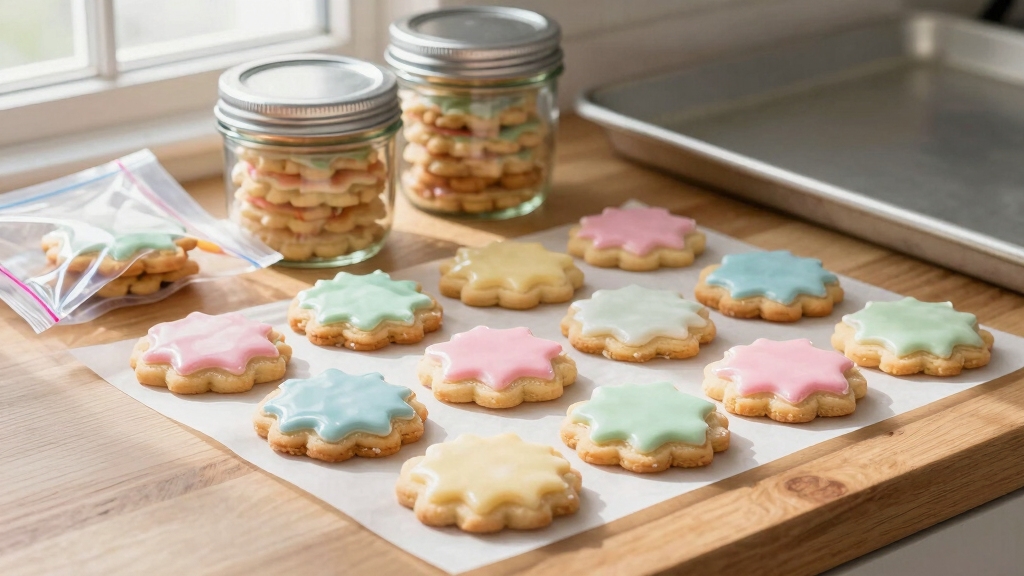
How to Store Icing Cookies Without Smudging Designs?
To store icing cookies, use airtight containers to keep out air and moisture. Store them in a cool, dry, dark place to maintain crispness and vibrant colors.
Layer cookies with parchment paper to prevent sticking and ensure decorations are fully hardened before packing. Avoid refrigeration, which can cause sogginess and decoration damage.
For longer storage, consider freezing fully dried, cooled cookies in sealed containers. Keep these basics in mind, and you’ll discover even better ways to preserve their freshness and beauty.
Key Takeaways
- Store icing cookies in airtight containers to prevent moisture exposure and preserve freshness.
- Ensure royal icing decorations are completely dry before packaging to avoid sogginess and smudging.
- Keep containers in a cool, dark, and dry place to maintain crispness and vibrant colors.
- Avoid refrigeration to prevent moisture condensation and softening of cookies and icing.
- Layer cookies with parchment paper inside containers to protect decorations and prevent sticking.
How Long Do Icing Cookies Stay Fresh at Room Temperature?

How long your icing cookies stay fresh at room temperature depends largely on the type of icing and storage conditions.
Buttercream-frosted cookies stay fresh for about five days in airtight containers. Buttercream sugar cookies remain edible for up to two weeks, though quality declines after five days. The quality and freshness can also be influenced by the shelf life of the ingredients used in the icing.
Decorated sugar cookies with royal icing last longer, typically 1 to 2 weeks, because the hard-drying royal icing protects freshness better than softer frostings. To maintain the best quality, it is recommended to store royal icing cookies in an airtight container and avoid exposure to air to prevent crusting and dryness airtight container preserves quality. General baked cookies keep well for about a week.
Best Containers for Storing Decorated Icing Cookies
To keep your decorated icing cookies fresh and intact, choosing the right storage container plays a significant role.
Opt for airtight containers that prevent air and moisture exposure, preserving icing quality at room temperature. Using containers with ergonomic handles can also make transporting your cookies safer and more convenient.
Choose airtight containers to keep your icing fresh and protect against air and moisture at room temperature.
Specialized flour box containers with labeled fill lines and included spatulas help organize multiple icing colors efficiently. These sets often come with custom labels that make planning icing measurements straightforward.
Multi-tiered systems like Bakers Sto N Go offer adjustable trays to separate cookies, avoiding smushing and color transfer.
Their clear design lets you monitor cookies without opening.
Look for food-safe materials with secure lids and handles for easy transport.
Removable trays increase versatility, accommodating various treat sizes.
Prioritize containers that protect delicate decorations through cushioned, compartmentalized storage, ensuring your frosting masterpieces remain pristine and ready to enjoy.
Problems Caused by Refrigerating Icing Cookies

Why does refrigerating icing cookies often do more harm than good?
When you refrigerate, trapped moisture softens the cookie and seeps into the frosting, causing loss of crispness and overly soft texture. Choosing proper storage methods and protective gloves can help maintain cookie quality by preventing temperature shocks and moisture exposure.
The fridge’s dry air pulls moisture from the cookie through sugary frostings, drying it out.
Condensation can form if cookies aren’t fully cooled before storage, leading to sogginess. Humidity and heat can cause condensation on or inside packaging, further impacting cookie quality.
Cold temperatures accelerate starch retrogradation, stiffening the crumb and speeding staling.
Fats in the cookie and frosting solidify, turning creamy frostings waxy and crumb textures hard, altering mouthfeel.
Additionally, royal icing can bleed at fridge temperatures, ruining detailed decorations.
These combined effects mean refrigeration often compromises both texture and appearance, so you should avoid it unless absolutely necessary. Using heat-resistant silicone gloves when handling hot or warm items can prevent moisture transfer and preserve cookie integrity.
How to Freeze Icing Cookies for Long-Term Storage?
Since refrigeration often harms the texture and appearance of iced cookies, freezing offers a better option for long-term storage.
First, let the royal icing dry completely, 8 to 24 hours, ensuring it’s hard and not tacky. Fully cool baked cookies to avoid sticking. Freezing decorated sugar cookies preserves quality when done with proper techniques. Utilizing airtight containers helps maintain freshness and prevents odors from affecting the cookies.
Layer cookies between parchment sheets in airtight containers, stacking upright if needed. Seal containers tightly or use vacuum-sealed bags, removing all air to prevent freezer burn.
Store up to 3 months for best quality.
| Step | Key Action | Tip |
|---|---|---|
| Drying | Let icing harden | 8–24 hours drying time |
| Cooling | Cool cookies fully | Prevents sticking |
| Layering | Use parchment layers | Avoid wax paper |
| Sealing | Airtight or vacuum seal | Remove air bubbles |
| Storage Duration | Freeze ≤ 3 months | Maintains flavor and texture |
How Do You Thaw Frozen Icing Cookies Without Damage?
How should you thaw frozen icing cookies to keep their delicate decorations intact?
Thaw them at room temperature inside their original sealed containers to prevent condensation from forming directly on the icing.
Lay cookies flat on a baking sheet rather than stacked to speed thawing to about 20 minutes and ensure even moisture distribution.
Keep cookies separated by waxed paper layers to avoid sticking and localized moisture buildup, similar to how crumb structure in sourdough bread requires careful handling for optimal texture.
Monitor the cookies during thawing, allowing 1-3 hours depending on humidity and temperature, and wait until all visible moisture evaporates before handling.
Avoid opening packaging prematurely to prevent sogginess and icing damage.
This controlled thawing preserves the icing’s appearance and elasticity, reducing risks of smudging, separation, or deterioration from thermal shock or humidity changes.
For best results, avoid thawing cookies in the same sealed bags to prevent moisture buildup and sogginess, which can damage the icing’s texture and look (Thawing Methods and Heating).
Storing Pre-Made Royal Icing Decorations Safely
Hey there! Before you store your pre-made royal icing decorations, it’s super important to let them dry completely. This way, you can avoid any sticking or mold issues down the line.
Once they’re dry, go ahead and grab some airtight containers to keep them safe. These will protect your lovely creations from moisture and any pesky environmental factors that might cause damage. Royal icing decorations should NEVER be stored in the freezer, as freezing is discouraged.
Oh, and here’s a little tip: consider adding some silica gel packets in with your decorations. They’re great at soaking up any extra humidity that might sneak in, ensuring your royal icing stays in perfect shape!
Drying Decorations Thoroughly
Why is thoroughly drying royal icing decorations essential before storage? If decorations aren’t fully dry, moisture trapped inside can cause them to soften, stick, or develop mold during storage. You want them crisp and stable for later use, so drying is key.
Royal icing is made primarily from powdered sugar and egg whites, which harden as they dry and create a durable finish. Proper moisture control is crucial in baking to ensure the final product maintains the desired texture and consistency.
To dry decorations effectively, consider these tips:
Allow 6-8 hours at room temperature. A surface crust forms sooner, but underlying layers remain soft.
Use a fan on low cool setting or a food dehydrator at 95°F to speed drying without texture damage.
For oven drying, use the lowest temperature (170°F-250°F) with the door cracked open, monitoring carefully.
Avoid enclosing decorations before fully dry to prevent trapping moisture and ruining their texture.
Following these steps ensures your royal icing decorations stay firm and ready for storage.
Airtight Container Storage
When storing your pre-made royal icing decorations, choosing the right airtight container is essential to preserve their texture and appearance.
Opt for glass Pyrex bowls with snapping lids or high-quality plastic containers that seal tightly.
Select container sizes based on the amount you have: 1-cup for under 5 ounces, 2-cup for 5-10 ounces, 4-cup for 10-15 ounces, and 7-cup for more than 15 ounces.
Make sure your decorations are completely hardened before transferring them to prevent sticking or damage.
Store containers in cool, dark, and dry areas to maintain quality for up to six months.
Avoid containers that allow air leakage, as exposure compromises your decorations.
Proper airtight storage eliminates the need for refrigeration, keeping your royal icing decorations safe and intact.
For best results, ensure optimal cooling practices to maintain the ideal texture before storage.
Moisture Protection Tips
How can you effectively protect your pre-made royal icing decorations from moisture damage? Managing humidity and moisture is crucial to preserving their intricate details and vibrant colors.
Start by controlling the environment where you dry and store your decorations. Use these tips:
Use a dehumidifier and air conditioner to reduce ambient moisture, preventing color bleeding and crater formation. Avoid sealing decorations while still warm; let moisture dissipate fully before airtight packaging. Because a dry bottom layer can worsen surface cratering by disturbing surface tension, timing your drying process is essential. Additionally, maintaining a consistent optimal humidity level helps prevent premature deterioration of the icing surface.
Include food-safe silica gel packets in storage containers, ensuring they don’t touch the icing directly. Consider vacuum packaging cooled decorations to remove excess air and moisture vapor, then defrost slowly in the refrigerator.
These steps help maintain the structure and appearance of your royal icing decorations, keeping them safe from humidity-related damage.
Common Storage Mistakes That Ruin Icing Cookies
When it comes to storing your icing cookies, it’s best to steer clear of the refrigerator. Why?
Well, the fluctuating humidity in there can really soften your cookies in no time. High humidity levels can also cause royal icing to lose its hardness and become sticky or soggy. Using an environment with a stable temperature and humidity, similar to that monitored by an oven thermometer, helps maintain cookie texture.
Plus, moisture exposure is a big no-no; it can ruin that lovely crisp texture and mess up the royal icing. So, let’s dive into some tips on how to avoid these pitfalls and keep your cookies fresh and intact!
Avoid Refrigerator Storage
Why should you steer clear of refrigerating your icing cookies? Refrigerators create moisture and temperature fluctuations that damage the delicate royal icing on your cookies.
Condensation forms when cold cookies warm up, making them soggy and sticky. Plus, the fridge’s humidity softens icing, leading to smudging and loss of crispness. This moisture intrusion can also cause decorations to dissolve, reducing the visual appeal of your cookies. Proper storage techniques, such as keeping cookies in an airtight container at room temperature, help maintain their texture and appearance.
Your cookies can also absorb unwanted flavors from nearby foods, ruining their taste. Additionally, icing can separate or change texture after refrigeration, requiring remixing or even discarding. Much like how fermentation temperature impacts sourdough bagel quality, stable storage conditions are crucial to preserving cookie integrity.
Avoid these pitfalls by keeping your cookies out of the fridge:
- Condensation ruins icing details and texture
- Humidity softens and smudges royal icing
- Flavors from other foods contaminate cookies
- Icing consistency deteriorates over time in cold storage
Prevent Moisture Exposure
Refrigerators aren’t the only threat to your icing cookies. Moisture from the environment can be just as damaging.
High humidity softens cookies and smudges icing. Condensation forms when moving cookies between temperatures. Avoid non-airtight packaging and improper stacking; they trap moisture and ruin crispness. When storing decorated cookies for short periods, using airtight containers can help maintain ideal icing consistency and prevent crusting.
| Moisture Source | Effect on Cookies |
|---|---|
| High Humidity | Softens cookies, smudges icing |
| Condensation | Causes sogginess, icing damage |
| Improper Packaging | Allows moisture absorption |
Use airtight containers with silica packets. Separate layers with parchment paper. Keep cookies dry and at stable room temperature to maintain crispness and icing integrity.
Don’t open containers prematurely or store in hot, humid areas to prevent moisture-related damage.
Storage Tips to Keep Icing Cookies Crisp and Vibrant
How can you keep your iced cookies crisp and vibrant after baking? Proper storage is key to preserving texture and color.
Use airtight containers with tight lids to block moisture and air, which can dull icing and soften cookies. Using airtight containers prevents moisture absorption from the air, keeping cookies fresh longer. Store containers in cool, dry spots away from sunlight to prevent color fading and flavor changes.
Layer cookies with parchment paper to protect delicate decorations and avoid smudging. To maintain crispness, place a fresh bread slice inside the container; it absorbs excess moisture without affecting flavor.
Choose glass or plastic airtight containers for protection.
Store in a cool, dark place to preserve vibrancy.
Layer cookies with parchment paper to prevent sticking.
Add a bread slice to balance moisture and keep texture crisp.
Following these tips keeps your iced cookies fresh and visually appealing longer.
Frequently Asked Questions
Can I Reuse Leftover Icing From Stored Cookies?
Yes, you can reuse leftover icing from stored cookies if you handle it properly.
Scrape off any dried crust before stirring in a small amount of water to restore consistency.
Test a small batch to ensure texture matches your needs.
Keep leftover icing covered airtight and refrigerate to extend shelf life up to a week.
Avoid reusing icing exposed to air for over 24 hours without protection to maintain quality and safety.
How Does Humidity Affect Icing Cookie Storage?
Humidity softens your icing, blurs your designs, and turns crisp cookies soggy.
When moisture sneaks in, royal icing bleeds colors and loses its firmness, while sugar cookies absorb condensation, losing their crunch.
You’ll want to store cookies in airtight containers in cool, dry places to keep humidity at bay.
Avoid heat and moisture spikes; otherwise, your beautifully iced cookies quickly become a sticky, soft mess.
Is It Safe to Store Icing Cookies With Other Baked Goods?
It’s best not to store icing cookies with other baked goods because moisture from them can soften or ruin your royal icing.
You should keep icing cookies in airtight containers, separate from more humid items, to maintain their crispness and design.
If you must store them together, use silica packets to reduce humidity and add parchment layers to protect decorated surfaces.
This keeps your icing cookies looking fresh and intact longer.
Can I Store Icing Cookies in Airtight Bags Instead of Containers?
You can store icing cookies in airtight bags, but treat them like delicate treasures. Airtight bags seal in freshness and prevent crusting if you press plastic wrap directly on the icing.
However, bags don’t stack well and risk crushing decorations. For short-term storage, bags work fine, but containers are your best bet for layered, decorated cookies to keep them pristine and prevent smudging or moisture buildup over time.
How Do Temperature Fluctuations Impact Icing Cookie Texture?
Temperature fluctuations can seriously affect your icing cookies’ texture.
When it gets cold, the royal icing becomes hard or brittle.
When it warms up again, condensation can form, making the icing soft or sticky.
These changes can cause smudging, bleeding, or even decoration damage.
To keep your cookies looking great, avoid exposing them to rapid temperature shifts.
Store them steadily at room temperature whenever possible.
Your Next Batch Deserves Better: How to Store Icing Cookies Right
You might think refrigerating iced cookies keeps them fresh, but it actually causes sogginess and dulls their vibrant colors.
Instead, store them in airtight containers at room temperature to maintain crispness for up to a week. If you need longer storage, freezing is your best bet; just thaw carefully to avoid moisture damage.
Avoid common mistakes like stacking wet icing or exposing cookies to humidity, and you’ll keep your decorated treats looking and tasting perfect.