
Can You Freeze Pretzels: Top Tips for Fresh Texture
You can freeze pretzels successfully by fully cooling them, then tightly wrapping each in plastic wrap and parchment to prevent moisture loss.
Use airtight freezer bags and freeze within 24 hours of preparation for best results.
Thaw pretzels at room temperature or briefly in the microwave, then reheat in the oven or air fryer to restore texture.
Proper handling preserves chewiness and flavor up to three months. Understanding these key steps ensures you maintain optimal quality throughout storage.
Key Takeaways
- Pretzels can be frozen effectively if fully cooled and tightly wrapped to prevent moisture loss and freezer burn.
- Fully mixed and kneaded pretzel dough freezes best, maintaining texture and gluten strength.
- Freeze pretzels within 24 hours of baking or delivery for optimal freshness and quality.
- Thaw pretzels slowly at room temperature or briefly in a microwave before reheating.
- Reheat frozen pretzels in the oven at 325°F or use an air fryer for best texture.
Pretzel Freezing Durability
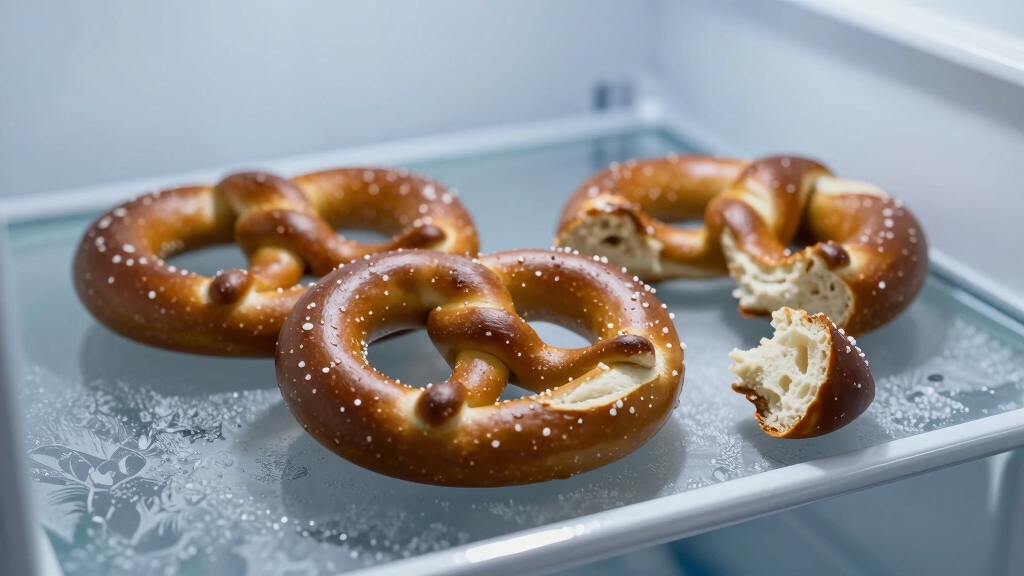
How does freezing impact the durability of pretzel dough?
Freezing preserves dough quality effectively if you manage thawing properly, ideally by slow thawing in the refrigerator overnight.
Proper thawing, especially slow overnight refrigeration, is key to preserving dough quality when freezing.
However, mishandling thawing can reduce dough rise, compromising final texture.
Over time, frozen storage increases dough hardness due to ice crystal recrystallization that mechanically damages the gluten network and starch granules, reducing springiness and viscoelasticity.
This structural degradation accelerates with repeated freeze-thaw cycles, which also elevate freezable water content and promote internal phase separation.
Despite these challenges, you can store pretzel dough for up to three months without significant quality loss, provided you avoid temperature fluctuations and refreezing thawed dough.
Maintaining airtight packaging prevents freezer burn and helps retain the dough’s characteristic chewy texture and flavor.
To maximize quality, freeze pretzel dough after it has been fully mixed and kneaded to develop gluten before freezing.
Using techniques such as stretch-and-fold during dough preparation can help strengthen gluten, improving dough stability before freezing.
Best Practices for Preparing Pretzels to Freeze
When preparing pretzels for freezing, you must ensure they cool completely to prevent moisture buildup that degrades quality.
Use cooling racks to spread pretzels evenly, facilitating airflow and preventing condensation on tops and salt dissolution.
This cooling phase typically takes 30 to 60 minutes, depending on pretzel size and room temperature.
Avoid placing warm pretzels directly into freezer bags, as trapped steam compromises texture.
Next, separate pretzels individually before freezing to prevent clumping.
Flash freeze them on a cookie sheet for about an hour so each pretzel solidifies independently.
This step maintains shape integrity and simplifies later portioning and reheating.
Maintaining an optimal temperature during this process helps preserve the texture and flavor of the pretzels.
Effective Wrapping and Packaging Techniques
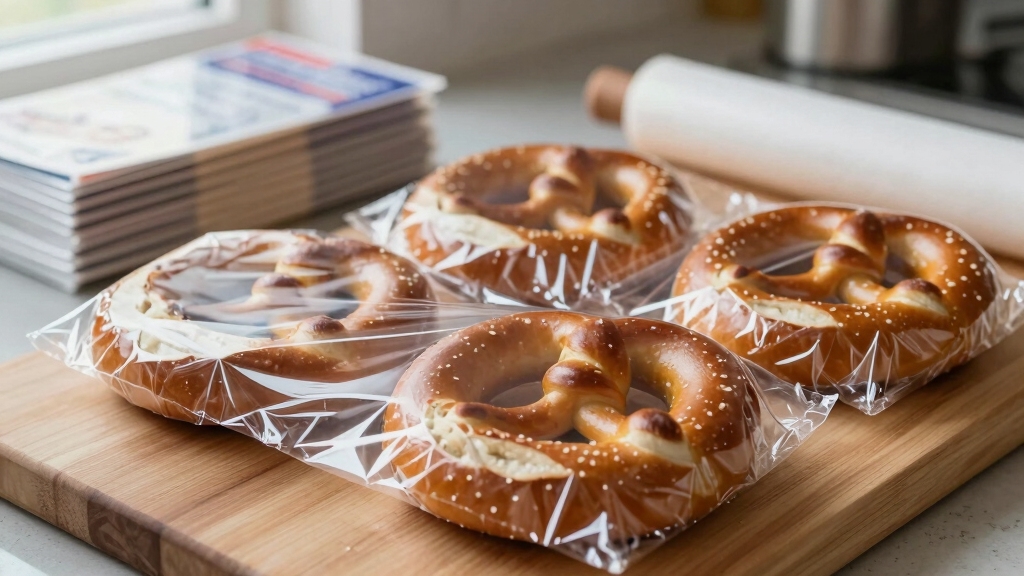
Effective wrapping and packaging techniques play an essential role in preserving pretzel quality during freezing.
To prevent moisture loss and freezer burn, tightly wrap each pretzel individually using plastic wrap or aluminum foil, both creating effective moisture barriers. Using airtight packaging also helps maintain moisture retention and prevents freezer burn.
Next, place wrapped pretzels in airtight freezer bags, removing excess air by pressing from the center before sealing. Double bagging enhances protection for long-term storage.
Use parchment or wax paper between layers to prevent sticking and maintain shape, especially when stacking. Proper air removal, including vacuum sealing or tightly folding foil edges, minimizes oxidation and flavor degradation. Additionally, frozen pretzels remain quality-preserving when kept properly frozen.
Finally, label all packages clearly with freezing dates to track storage time and ensure consumption within the optimal three-month window.
These precise methods maximize freshness and texture retention during freezing.
Recommended Storage Containers and Methods
Which storage containers best preserve pretzels during freezing depends on their airtightness, material properties, and size. Airtight containers like resealable freezer bags, especially Ziploc freezer bags, effectively reduce freezer burn by limiting air exposure.
Using airtight containers is important because even hard pretzels benefit from airtight storage to maintain their longer freshness. Freezing also helps preserve the original texture and flavor, similar to techniques used for sourdough bread.
Glass containers such as Prep Naturals or Seed & Sprout provide durability and non-toxicity. They withstand freezing without warping, maintaining pretzel texture and flavor. Clear plastic options like Rubbermaid Brilliance offer microwave and freezer safety but may risk moisture accumulation.
Choose shallow containers to avoid crushing pretzels when stacking. Separate layers with parchment paper to protect toppings. Consider container size for portion control and efficient storage; quart-sized bags fit Instant Pot liners for convenience.
Label all containers with freezing dates to track freshness. Prioritize airtight, freezer-safe, appropriately sized containers to maintain pretzel quality during freezing, as this method aligns with best practices for preserving baked goods’ flavor profile and texture.
Ideal Reheating Procedures for Frozen Pretzels

To reheat frozen pretzels effectively, you’ll want to keep an eye on both the temperature and moisture. This way, you can preserve that delightful texture we all love. So, if you’ve got larger pretzels, go ahead and preheat your oven to 325°F.
A little tip: misting them with some water or wrapping them in foil can help keep them soft while crisping up the crust nicely. Proper reheating aims to replicate a “just baked” feel, ensuring the best flavor and texture. Proper storage preparation before freezing can also enhance their freshness upon reheating.
Now, if you’re dealing with smaller batches, the air fryer is a fantastic option. Set it to 325°F, and you’ll have those pretzels heated up quickly with deliciously crisp edges. On the other hand, if time is of the essence, you can always pop them in the microwave. Just remember to cover them with a damp paper towel for a quick reheat, but keep in mind that this method mightn’t give you the same textured result as the others. Happy reheating!
Oven Reheating Tips
How should you prepare your frozen pretzels for ideal oven reheating?
First, preheat your oven according to the pretzel type: 325°F for standard soft pretzels, 425°F for Milwaukee, Gus, and Auntie Anne’s pretzels, and 350-400°F for SuperPretzels.
Next, lightly moisten the pretzel’s surface with water or butter to maintain softness without sogginess; use a spray or brush method for even coverage.
After dampening, apply pretzel salt to enhance adhesion and flavor, given the dough’s existing salt content.
Place pretzels on a baking sheet or directly on the middle oven rack. Wrapping in foil yields a softer crust, while direct placement promotes crispiness. For best results, preheat oven to 325 degrees Fahrenheit when reheating standard soft pretzels.
Bake frozen pretzels for 5–15 minutes at the specified temperature, monitoring for a lightly crisp exterior and soft interior to ensure optimal texture and flavor.
Microwave and Air Fryer
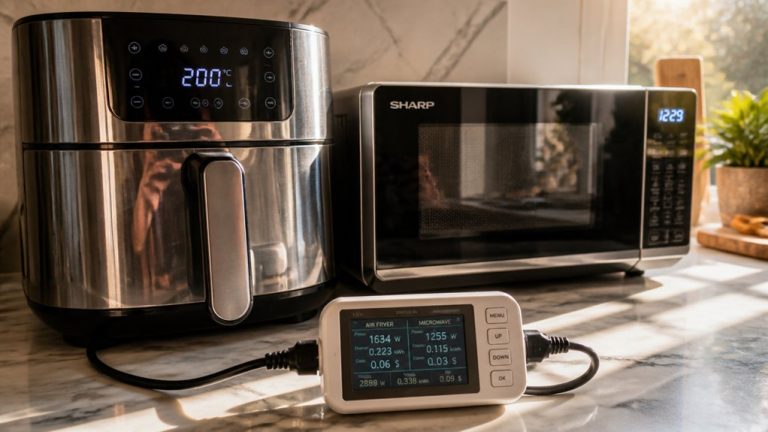
When reheating frozen pretzels quickly, you’ll find that microwaves and air fryers offer distinct advantages and limitations.
For microwaves, wrap the pretzel in a damp paper towel to retain steam. Microwave on medium power for 15–20 seconds. Microwave heating is a suitable option for thawed pretzels and typically takes 30 to 50 seconds when fully thawed. Proper moisture and controlled timing are critical to preserve texture and flavor during reheating, similar to how frosting texture affects cake quality.
Let it rest briefly to allow internal steaming. Use this method only in a pinch, as microwaving risks a rubbery texture. Follow up with toasting if possible.
Alternatively, the air fryer preheated to 325°F provides superior texture. Lightly mist the pretzel and heat for 3–4 minutes.
This produces crisp edges with a soft interior, ideal for nuggets or single pretzels. Avoid multiple reheats and always remove pretzels from plastic before microwaving.
Proper moisture and controlled timing are critical to preserve texture and flavor during reheating.
Shelf Life Expectations for Frozen Pretzels
Shelf life expectations for frozen pretzels vary considerably depending on their type and storage conditions.
Homemade pretzels maintain optimal quality for up to 2 months when tightly wrapped and stored in heavy freezer bags with minimal air. Proper preparation includes cooling pretzels completely before freezing to preserve texture and flavor freezer storage. Using precise measurements and proper fermentation techniques can also help maintain the pretzels’ texture after freezing.
Commercial soft pretzels, formulated for extended storage, last up to 12 months at 0°F or below, provided they thaw fully before repackaging.
Gluten-free pretzels also sustain quality for approximately 12 months frozen.
Bavarian-style pretzels retain taste and texture for 3 months frozen, with refreezing allowed for 3-4 weeks post-thaw.
Jumbo frozen pretzels offer a 1-year shelf life when immediately frozen upon delivery.
Beyond these durations, expect significant degradation in texture and flavor, underscoring the importance of adhering strictly to recommended frozen storage timelines for each pretzel variety. Attention to fermentation and dough development is key to preserving pretzel quality through freezing and thawing.
Tips to Maintain Quality and Freshness During Freezing
Why does freezing pretzels require careful preparation? Proper cooling, wrapping, packaging, and thawing protocols are essential to preserve texture and freshness. Using the right storage tips can help maintain quality during freezing.
Cooling pretzels completely at room temperature (30-60 minutes) prevents condensation and sogginess.
Wrapping each pretzel tightly in plastic wrap with parchment paper protects against freezer burn and sticking.
Use airtight freezer bags or containers, freezing within 24 hours of delivery for optimal shelf life (up to 3 months). Since pretzels are baked fresh without preservatives, it is important to unbox and freeze them promptly upon arrival to maintain quality handling upon arrival.
Thawing at room temperature or microwaving briefly ensures softness without compromising quality.
| Step | Key Action |
|---|---|
| Cooling | Cool fully, 30-60 min, avoid moisture buildup |
| Wrapping | Individually wrap, use plastic and parchment |
| Packaging | Use airtight bags/containers, freeze quickly |
| Thawing/Reheating | Room temp thaw or low microwave, oven reheat recommended |
Frequently Asked Questions
Can You Freeze Pretzel Dough Before Baking?
Yes, you can freeze pretzel dough before baking, storing it up to three months in an airtight container.
Start by freezing shaped dough pieces on a parchment-lined baking sheet for about one hour until firm.
Then transfer them to a freezer-safe bag to prevent sticking.
When ready, thaw the dough overnight in the refrigerator, allow it to rise at room temperature for an hour, and proceed with boiling and baking as usual for optimal texture and flavor.
Does Freezing Affect Pretzel Flavor or Texture?
Freezing doesn’t negatively impact pretzel flavor or texture if done correctly.
You’ll lock in freshness and halt flavor degradation by freezing soon after baking.
Texture-wise, chewiness and a slight crisp exterior remain intact, provided you wrap pretzels properly to avoid moisture buildup and freezer burn.
When reheated at 350°F for 8-10 minutes, you’ll restore the golden-brown crust and chewy interior, preserving the original bakery-quality taste and mouthfeel effectively.
Are Gluten-Free Pretzels Freezer-Friendly?
Freezing gluten-free pretzels is like preserving a treasure chest of flavor!
Yes, they’re freezer-friendly when you wrap them tightly in double layers of plastic wrap or foil, then store in airtight containers.
This method keeps them fresh up to three months. Avoid salting before freezing to prevent moisture loss.
When thawing, sprinkle water and reheat in a toaster oven at 300°F to restore softness and taste effectively.
Can You Freeze Pretzel Bites or Only Whole Pretzels?
You can freeze pretzel bites as easily as whole pretzels, especially since many come packed in freezer-safe bags designed for long-term storage.
Freezing preserves their texture and flavor for up to six months if you avoid thawing and refreezing.
When reheating, bites require 3-4 minutes from frozen to regain a crisp exterior and soft interior.
This method maintains quality and convenience, making pretzel bites suitable for freezer storage just like whole pretzels.
Is It Safe to Freeze Pretzels With Toppings Like Cheese?
Yes, you can safely freeze pretzels with cheese toppings if you follow proper steps.
Freeze cheese-stuffed pretzels up to four months in airtight containers after cooling.
Avoid freezing soft cheese toppings like cream cheese frostings, as texture degrades.
When reheating, use a 300°F oven for 8-10 minutes to maintain gooey filling.
Proper wrapping and storage prevent freezer burn and preserve safety and quality during freezing and thawing.
Freezing Pretzels to Keep Chewy Texture
You might think freezing pretzels compromises their fresh, chewy texture, but using the right wrapping and storage methods actually preserves their quality remarkably well.
By preparing them properly and reheating with care, you can enjoy nearly the same taste as freshly baked pretzels.
While freezing extends their shelf life considerably, neglecting these steps risks sogginess or staleness.
In short, freezing pretzels is both practical and effective if done with precision.